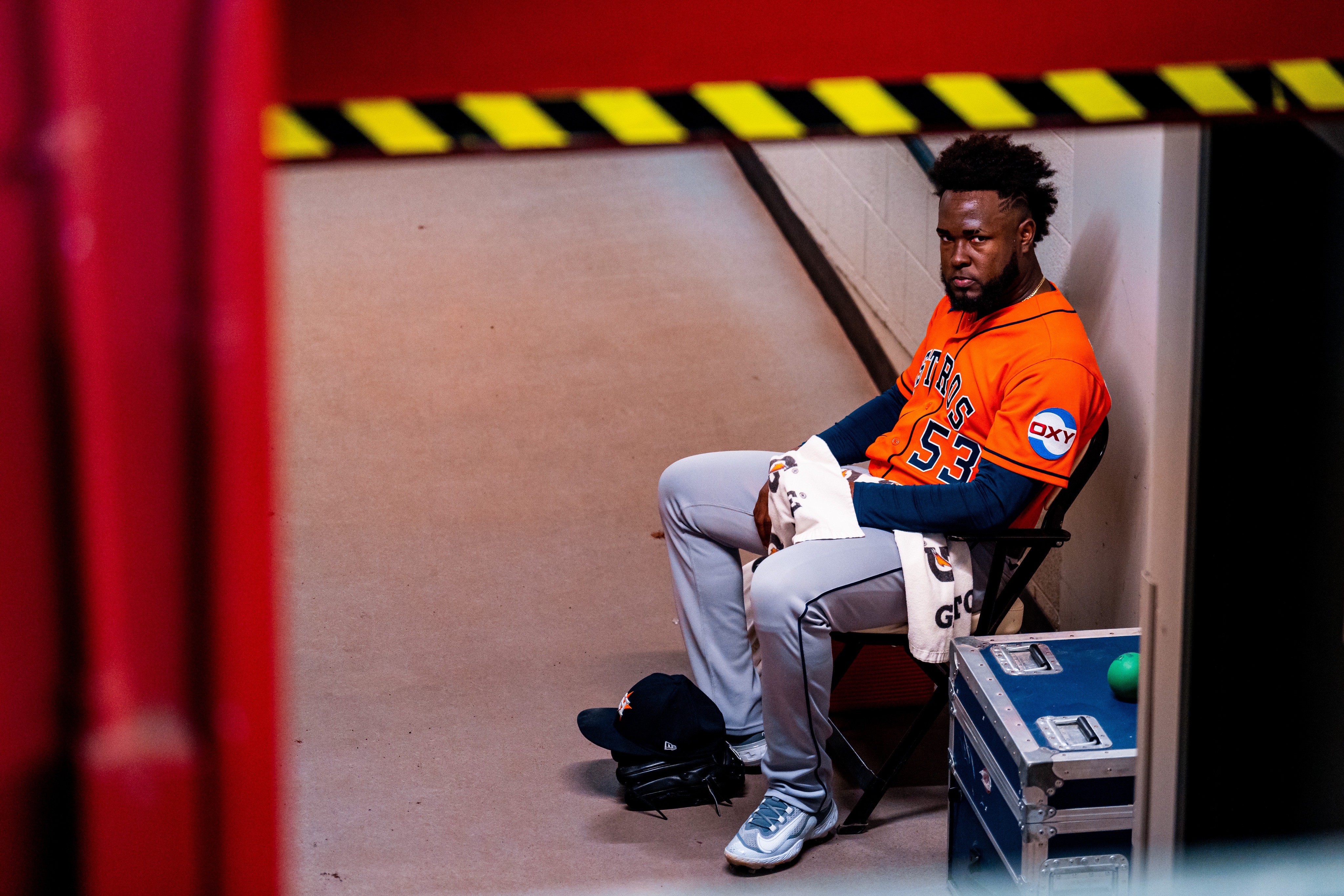
As the Astros furiously try to catch up with the AL West leaders, the question arises: how did the Astros, once regarded as league leaders in developing pitchers, get in this position? The Astros start to the season began with a thud as the starting pitching seemingly fell off a cliff. The Astros’ pitching staff has moved closer to “normal” with the 14th ranked ERA and 10th ranked x-ERA over the last 30 days. This is large part due to the bullpen which has stabilized the pitching, despite continued volatility in the rotation.
Despite signs of improvement, the Astros’ rotation over the last 30 days still sits around the lower third of the league in ERA and x-ERA. This is a brief post without any real answers, triggered by Dan Symborski’s Fangraphs article about pitching underperformers so far. The article, “ZIPS Mid Season Movers and Shakers-Pitchers,” examines the pitchers, at the mid-season mark, who have most over-performed and under-performed their pre-season ZIP projection. The table of starting pitcher underperformers is of particular interest to Astros’ fans.


The Astros have four players on the list of top under performing starting pitchers in the major leagues: Mike Burrows, Cristian Javier, Ryan Weiss, and Tatsuya Imai. No other team has four starting pitchers on this list. The A’s have three, but that includes AAA players whom underperformed in the minors this year. A handful of teams, have two under performing starting pitchers on the list. But the notable observation is that the Astros have the most underperforming starting pitchers.
Underperformance is defined by the degree that updated projections for 2026 are less than the pre-season projection. So, in a sense, this list is measuring the extent that the ZIPS model has updated projections based on the actual ERA under performance which has already occurred. For the four Astros’ pitchers, the updated ZIPS projection for 2026 reflects a loss of approximately 2.5 WAR.
These four pitchers under performed not only Astros’ expectation, but also industry expectations–if you want to consider the ZIPS system as a representation of accepted projections within the baseball industry. How did this happen? One possibility is bad luck, and there is some support for that notion. All of the four pitchers have an x-ERA of one to four runs less than the actual ERA, meaning that they have suffered some bad luck. But those x-ERA figures in most cases are higher than the pre-season projected ERA. (For instance, Javier has an x-ERA of 7.49, even though his pre-season ERA projection was in the mid-4’s.) Maybe the pitchers encountered some bad batted ball luck, but it does not explain the overall under performance.
Three of the Astros under performers (all but Javier) are new additions to the team. It’s possible that the criteria utilized by the team in acquiring starting pitchers is responsible for the outcome. My view is that the ABS strike zone is most detrimental to the Astros preferred starting pitcher profile, as I discussed here. Furthermore, all 4 starting pitchers are right handers, and the high walk rates are mostly concentrated among left hand batters, as I discussed here.
It appears that the Astros’ pitching department places greater value on stuff and K/9 than control and BB/9. This has served the Astros well for many years. But for three of the under performing pitchers, the actual BB/9 is 40% to 100% higher than projected. For the fourth under performer (Burrows), the actual BB/9 is slightly higher than projected. This is consistent with the view that the small ABS strike zone is a root cause for the under performance. I suspect that the Astros’ pitching analysts/coaches didn’t realize the significant impact of the new strike zone, in terms of both pitching and batter behavior. And most likely the projection systems didn’t foresee this impact either.
I believe that control/command pitchers’ value has increased relative to pure stuff pitchers in this era of higher walk rates. Given that the Astros’ acquisitions appear focused on stuff and strike outs, the outcome has been less than optimal. Keep in mind that the K/9 for the four under performing pitchers is pretty good–and in the case of Weiss and Imai, the K/9 is much better than projected. The Astros are a top 10 team in rotation K/9 (8.85). But it’s the severe under performance in BB/9 which is a major causal factor for the Astros’ rotation troubles.
Feature photo from @astros on X, Source Link.


































What the Astros want from their pitchers have changed through the years. If memory serves me well, Strom wasn’t fond of the sinker and introduced the high spin. Later came the “rising” four seamer. Then, the sinker was allowed to the groundballers. Also, the ineffective pitches were removed from the pitchers’ arsenal and the usage was optimized. Now, I don’t know what they do. Maybe they plugged the leaks to the press or I lost interest in the Espada’s Astros.