
The Astros pitching has been bedeviled by walks this year. They are the worst in the majors with a BB/9 rate of 4.90. However, the picture is different if you look at platoon splits. The Astros pitching staff is last in BB/9 against LHBs (6.12) but closer to middle of the pack (19th) against RHBs (3.53). The league in general tends to put up worse walk numbers against LHBs, but the platoon difference is smaller. Against LHBs, the league BB/9 is about one half run higher. For the Astros, the differential is 2.59 BB/9.
The Astros currently don’t have a LH starting pitcher, which may have a small effect in favor of walking lefty bats, but it’s not the most important factor. The pitching stats above incorporate the bullpen which includes several frequently used LHPs. Lefties like Steven Okert and Bryan King have been used fairly frequently in the daily relief work. Among righties in the bullpen, Bryan Abreu has a massive BB/9 close to 16 versus LHBs, which is nearly 9 BB/9 higher than his walks against RHBs.
However, I think the walk rate among Astros starting pitchers is particularly revealing. The disparity versus LHBs creates a considerable incentive for opponents to load their batting order with LHBs. And that is something we have seen quite often. The Guardians loaded their lineup with 8 or 9 LHBs (or switch hitters). It’s not that unusual for Astros starting pitchers to face 7 LHBs.
With the exception of Lance McCullers Jr. (who has few platoon splits for his walks), the Astros’ starters exhibit highly elevated walk rates against LHP.
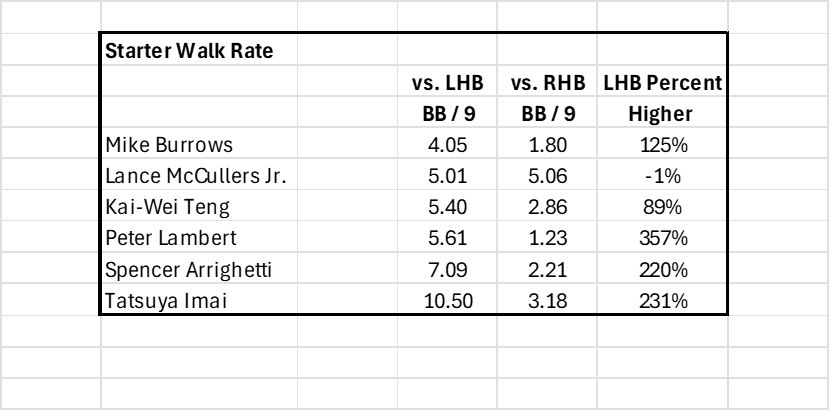
With the exception of McCullers, the current Astros starting pitchers have good-to-decent walk rates vs. RHBs. However, walk rates against LHBs are elevated to as high as 10.50 BB/9 (Imai) and 7.09 (Arrighetti). The LHB percentage ranges from 89% to 231% higher than the BB/9 against RHBs.
There could be varying explanations depending on the pitcher. RHPs generally use an off-speed pitch like the sinker, change up, or splitter to suppress LHBs. It’s possible that these pitches are more difficult to control for particular pitchers. But based on observation, it seems to me that many of the misses to LHBs are on the outside (away) part of the plate. This makes sense because RHPs often try to stay away from lower inside pitches to LHBs. The pitchers may be trying to touch the outside boundary of the zone, and that kind of precision can be difficult.
The ABS strike zone made a significant change to the upper boundary of the zone, as I’ve previously written. In addition, the ABS strike zone is about 1 inch smaller width from the zone typically called by umpires in 2025. The ABS zone is based on the actual width of the plate and eliminates the small buffer around the edges which was previously used to grade umpires. In this new world of the ABS strike zone, pitchers are targeting the outside (away) boundary of the LHB and face a smaller margin for error.
Fangraphs’ Ben Clemens has attempted to analyze the factors causing the rapid increase in the walk rate around the league. The direct effects of ABS (challenges) are minimal because pitch call reversals are a miniscule part of overall pitches. But the indirect effects are more significant because the ABS strike zone leads to behavioral adjustments by umpires, pitchers and hitters. For instance, batters are swinging less. The swing rate for pitches “just above” and “just outside” the strike zone are 4.08% and 5.8% less than in 2025. In addition, most of the increase in walks occur in 2-2 and 3-2 counts.
In addition, umpires are calling fewer strikes “just above” and “just outside” the strike zone. The Fangraphs article focuses on 3-2 counts, which contribute the most to higher walk rates. Clemens’ chart below shows the change between 2025 and 2026 strikes called by location.
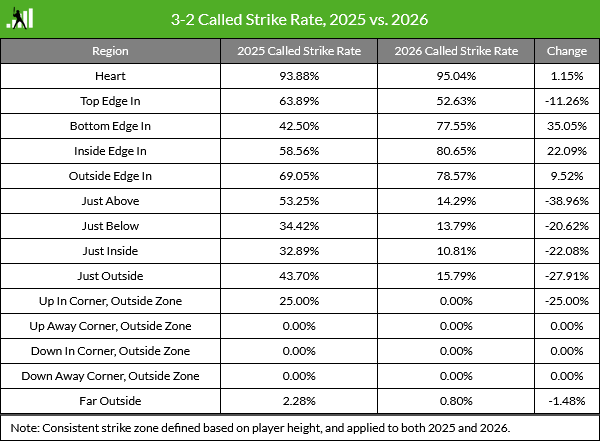
As the Fangraphs article shows, the called strike rate for “just outside” declined from 44% in 2025 to 16% in 2026. Similarly, the called strike rate for “just above” declined from 53% to 14%. These are really substantial changes in pitchers’ ability to get called strikes “just outside” and “just above” the zone compared to last year. If one assumes that the RHP attempts to pitch away from LHBs with occasional pitches to LHBs at the top of the zone, the pitchers must exhibit significantly greater precision than they were used to in 2025.
So my hypothesis is that the Astros’ starting pitchers try to hit the outside edge but end up just outside and away from LHP. Because batters are swinging less and strikes are not called as frequently, they end up walking too many LHBs. Of course, this doesn’t necessarily explain why they are worse at walking LHBs than other teams’ pitchers. Maybe they have not focused on attacking LHBs in the past. And it becomes more obvious now that opponents are loading up on LHBs in their starting lineups.


































I was loading up to ask why we suck so much harder than the rest of the league but have to figure a big part of our pitching instruction was focused on hitting the shadow zone and it’s a bigger adjustment. And our guys aren’t exactly known for pinpoint control to begin with
Continue to be disappointed that our team seems to have been behind the 8-ball in adjusting to what was going to happen this season which feels very different that our past iterations but hopefully we continue to adapt