
The advent of the automatic balls-strikes system (ABS) required minor changes to the MLB strike zone. But it’s not a change to the rulebook zone. Instead, the strike zone changes were necessary to implement ABS challenges. However, it’s reasonable to assume that this is the same as a rulebook change, since umpires and pitchers adjust their own recognition of the new strike zone in order to avoid successful challenges.
I will also explore the Astros’ pitching style over the past 10 years which has been highly sucessful, theorizing how the ABS zone may interact with that approach to pitching. Because the Astros have started the season with terrible pitching results, this may suggest one potential factor affecting the pitching results.
The main difference in the new ABS strike zone is that it is smaller. On average the zone is 60 square inches smaller than last season. This varies from player to player, as well as the ball-strike count, since umpires’ perceptions of the zone varied with the count. With the ABS zone, the strike zone is based on a fixed percentage of each player’s height.
The most obvious change in the strike zone is the location of the top rail of the zone. The top boundary is 53.5% of the player’s height for the ABS, but the top boundary, on average, was 55.6% of the player height in previous seasons. Depending on the player’s size, this is equivalent to an approximate 2 – 4 inch reduction in the top of the zone. For example, in the case of a tall player like Aaron Judge, the reduction is 3.8 inches.
Pitchers have noticed the difference. Last year’s Cy Young winner, Tarik Skubal, said, “I think the general consensus is the top of the zone is lower than it should be, I still think the zone should go up a little bit, in terms of what the strike zone is — what it actually is, not what we have it as right now.”
Since the strike zone is smaller, we should expect more walks. This happened in the minor leagues when ABS was introduced, and it’s a natural consequence of the new zone. So far this season, walks/9 and bases on balls have increased league wide. League BB% is approximately 16.6% higher than last year (9.8 / 8.4). As you probably are aware, the Astros pitchers have been terrible at issuing walks. The Astros have the highest BB% (13.6%) in the majors, and Astros pitchers’ BB% , incredibly, is 61.9% higher than last year (13.6 / 8.4). So far this season the Astros’ pitching deficiencies are exemplified by moving from an average walk percent to the highest walk percent in the league.
The Houston Astros’ “top of the zone” pitching style is a core part of their organizational pitching philosophy instituted by former pitching coach Brent Strom. The philosophy has produced almost ten years of pitching success and focuses on high-spin four-seam fastballs designed to generate “rise” and induce swings-and-misses or weak pop-ups. Strom favored combining this “vertical carry” approach with sharp breaking balls which drop low in the zone and appear to begin in the same tunnel as the fastball. Examples of successful implementation of this approach include Gerrit Cole, Justin Verlander, Cristian Javier, and Hunter Brown.
Not only do you see this philosophy in the tweaks made by Astros’ pitching coaches to players’ deliveries and pitch mix, but also in the selection of pitchers through trade, draft, and free agent signing.
The Astros came into this season with many additions to their pitching staff. But most of those new pitchers (in particular Tatsuya Imai, Ryan Weiss, Mike Burrows, and Cody Bolton) seemed to be consistent with the Astros’ vertical, “high fastball,” philosophy of pitching.
But the results have been bad. The Astros are ranked 30th in ERA (5.81) and 25th in SIERA (4.37). The Astros continue to strike out batters–the pitching staff is ranked 3rd in K/9 (9.74), but the main weakness is the substantial increase in BB% and hit by pitches–worst in the league on both measures.
Given that the Astros’ pitching philosophy is anchored by high fastballs at the top of the zone, it’s pretty easy to draw the connection to the reduced height of the top boundary of the strike zone. In theory, the new lower top of the zone can diminish Astros’ pitching results in several ways:
- Making it harder to throw strikes within the lowered top boundary
- Making it easier for batters to lay off pitches just above the top of the zone
- Creating more hittable pitches at the top of the zone and just above the top boundary
- Reducing the pitcher’s margin of error.
As illustrated in this comparison of Bobby Witt Jr. ‘s strike zone before and after ABS, a pitch at the top rail which is roughly near the belly button last year is now at or below the belt buckle with the new ABS zone. The new top of the zone is closer to the center of the zone, making it more hittable. Just above the top boundary would have been nearly unhittable last year, but it also becomes more hittable with the new zone. Moreover, the margin for error is less, meaning that a pitcher targeting the top rail who misses might put the pitch in the extremely hittable center of the zone.
I have used the Brooksbaseball.net database to compare Mike Burrows’ exit velocity by strike zone location for 2026 to date and for 2025. Assuming that Burrows will target just below the top rail or just above that location, my review focuses on the top 3 squares below the top boundary and the 3 squares above that boundary.
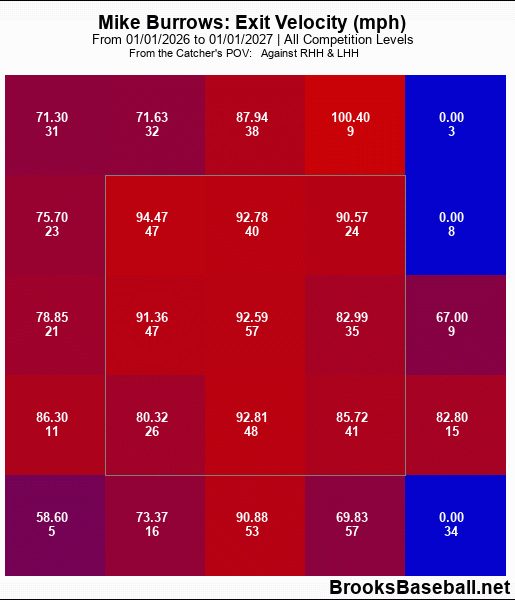

In 2025, for pitches just below the top boundary, only one zone (center) had high exit velocity. But so far in 2026, all three zones just below that boundary had high exit velocity.
In 2026, for pitches above the top boundary, one zone produces high exit velocity, but in 2025 no zones at that level produce high exit velocity.
Burrows has relatively good control (his 2026 BB/9 is only slightly above his 2025 BB/9 results), has shown continued good strike out numbers (8.44 K/9), but his results have been poor so far (6.75 ERA). There is strong evidence that he has been affected by bad luck on batted balls, as demonstrated by his 3.89 x-ERA and likely unsustainable .389 BABIP. However, another factor could be the increased hittability of pitches at the top of the zone, which may be connected to the larger ABS strike zone.
I suspect that some of the staff’s poor pitching results will regress somewhat in the future. But I wouldn’t ignore the smaller strike zone at the top boundary. This may not be the primary cause of the poor results from the Astros’ pitching staff, but it could be a significant factor. The revised strike zone puts greater pressure on the pitchers to show greater precision at the top of the zone. And it may lead to harder hit balls because the location is more easily handled by the hitter. It’s possible that the pitcher will over-compensate by trying to keep the pitch from falling into the upper quandrant of the strike zone, result in more walks and longer pitch counts.
It will be interesting to see how both hitters and pitchers respond to the strike zone changes. On average, the bottom boundary of the strike zone has increased an inch or more due to the ABS strike zone. This could create an opening for teams to rely more on groundball pitchers who rely on the sinker just below the bottom boundary.
Feature photo by Keith Allison. Creative Commons License.


































,_Cleveland_coach,_umpire_Adam_Hamari_(78)_,_umpire_Kerwin_Danley,_umpire_Ryan_Blakney.jpg)
This reminds me of a shift in umps calling pitches at the bottom or just under the bottom of the zone strikes and Keuchel. When they were consistently giving him the bottom edge or just under, Keuchel was an untouchable pitcher and when you did hit him it was always soft rollovers. In 2018, they seemed to not give him that as much and it crippled his effectiveness. He was still serviceable but it was the beginning of the end for him.
So are other high vertical fastball pitchers around the league seeing similar reductions in effectiveness with this removal of the top part of the zone?
I just started looking up some fastball pitchers randomly. Man, since the Astros knocked Crochet around on April 1, it’s been some tough going for him.
Interestingly it looks like the strike zone now will be more welcoming to Keuchel type pitchers. Also, probably helpful for Framber or anyone who depends on those low strikes. It makes me think that Jason Alexander might benefit if he is called up.
Bringing Alexander up into the rotation makes more sense to me than trying to convert Teng. He’s been an effective pen piece in a pen that needs all the effective pieces it can get.
And Alexander likes to use the bottom of the zone, since he is a pitcher who combines a sinker with a downward dropping change up.
I thought about your question regarding other high FB pitchers at the time, but I couldn’t come up with a good way to separate the field into guys who specialize in the vertical carry approach. I find myself relying upon personal observation of the pitchers in the past, which isn’t very objective. I would note that Severino is a pitcher who always made his name with a high 97/98 fastball at the top of the zone, and he is having results similar to the Astros pitchers: a high K rate, high velocity on both 4 seamer and 2 seamer, but a terrible BB/9 over 7, which leads to a 6+ ERA. Skubal is perhaps the best at using FBs in the high strike zone and he seems to be as great as always. Maybe guys who have really, really good stuff and precision can deal with the zone changes just fine. Freddy Perralta whom the Mets picked up from the Brewers is pitching somewhat worse than expected, but I’m not sure of the cause. You can easily get into cherrypicking just picking out high fastball pitchers that are on my mind.
This FG headline provides another candidate for inclusion the high fastball decliners:
The Phillies Need Help. Jesús Luzardo Needs an Exorcism.Luzardo’s stuff looks better than ever. How in the heck is he running a 6.91 ERA?
Good analysis as expected, but it really has me wondering what the long term future holds for not just us, but a lot of clubs.
Obviously, an elite pitcher like Skubal, or Diesel for that matter, will adjust. Whether that’s tweaking their control, altering their sequencing, etc. It seems like most of them (I’d include Crochet in this) have enough “stuff” to sacrifice a little effectiveness if necessary to adapt to the new, lower zone. And most will right the ship, if they haven’t already.
What worries me is how sudden the shift is. I love ABS for a lot of reasons, but it might cause some institutional whiplash and suddenly have us chasing down groundballers and guys with an entirely different primary pitch mix than we’ve been focusing on for literally ten years. I can see a lot of growing pains with that, if the entire pitching lab (analytics guys down the chain to coaches) can’t quickly get on board.
In the short term, we’ve probably got the ability to target underrated sinker pitchers and “control guys” over the course of this season and the next, but longer term, I suspect how we construct a rotation is going to be significantly altered by this.
It’s easy to regret not signing Framber given how perfect he is for this, but I still think there was zero chance he stayed with the team after the Salazar incident, so the point is moot.
Also worth noting: Jose Soriano has really benefitted from the new zone. It wasn’t just our offense having a bad night against him on opening day, he has been absolutely elite this year and damn near unhittable. While I have always thought of him as a TOR arm, he’s looked like a CY candidate this year, and I can’t imagine the new zone hasn’t significantly helped him there.
Maybe we should look to him as the model for the next starting pitcher we pursue, whether in free agency, trade, draft, etc. A groundballer with elite velocity who, unlike Framber, does not lose effectiveness as he throws at max effort.
I always felt that Soriano was under-valued. Then he has the perfect circumstance to break out as elite this year. I have always like high GB% pitchers because they can get outs even if they have an off-day with their stuff.
The top of the zone problems intrigue me, and it wasn’t one I considered deeply when contemplating ways to adapt to the new ABS changes.
Given the top zone & tunneling philosophy the Astros have historically favored, that clearly needs to adjust.
The bottom of the zone and ground balls is probably something that could be temporarily exploited, until the batters adjust and once again return to their lift & launch angle counterattack.
I hypothesize the inside/outside edges are the best way to use the ABS change. Umpires can be easily fooled by those, and batters don’t like to swing at them unless they’re sitting and expecting it.
This would suggest more traditional sliders & sweepers and favor control pitchers over velocity guys.
However, this approach is quite at odds with the main Astros pitching philosophy and favored pitcher selection.
I’ll be interested in later investigating the success of those pitches being called for strikes when we get some more games in as compared to previous years, and if we see more of them being used, in the aggregate.
I have seen reports that teams are trying to nip the corners at the top of the zone. The reason: the old strike zone called by umpires had rounded corners. The new strike zone has square corners (because it is 2D and not 3D). This gives a little extra space on the corners. I have seen pitchers on both sides trying to clip those top corners. (It seems like a lot more than prior years.) I think you would need really good precision to do it. And it seems to produce a lot of balls just off the corner.
Makes me think Houston’s issue is not a Katz issue but a pitching development 360 that we are suffering the effects of. It reminds me a bit of how we saw Houston’s defense drop like a rock after the shift was banned.
Houston might just need to get a new brain in the pitching department/analytics department and adjust to the new trend.I know our new farm system director Niedorf was more of a pitching director for the minor leagues for Texas.
I’d argue that *is* a Katz issue. We knew this was coming as well as any other team. Why bring on a “new guy”, with Murphy leaving, who apparently can’t assist with the single greatest change to the pitching environment since the clock?
Katz may or may not be responsible for anything but the hire is a failure.
ABS was in effect in spring wasn’t it?
Why didn’t this manifest in spring? Just the nature of pitch selection in spring differing from when game count Va when you’re just working on specific stuff? Too small a sample size?
Let me add one other piece of evidence–from the offensive side. If the lowered top of the zone has hurt pitchers who specialize in that approach, then it also means hitters who were vulnerable to that approach are facing better conditions. Two hitters who were well known to have a weakness on FBs at the top of the zone come to mind: Mike Trout and Christian Walker. Walker currently is headed for a career best in K rate (16%) and BB rate (12%). Mike Trout currently has his best K rate (20%) since 2019 and an unbelievable BB rate of 22%.
This makes me wonder if these changes and effects of implementing ABS challenge were identified when it was being beta’d in the minors. Did other organizations see this coming? Did the Astros not?
Good question. I’m pretty sure MLB knew what was coming. They did a lot of analytics work on the minor league data. Whether particular teams did, I don’t know. I suspect that the Yankees knew, because all spring their managers and coaches were talking to the media about the need to understand and deal with ABS. Their manager, Boone, said he was “obsessed” about getting ahead of the curve on the effects of ABS.
I believe that. Their catching coach, Tanner Swanson, is very very analytics minded dating back to when he was with the Twins staff. I bet he pored over this stuff to find the best angles on it.