On April 30, I wrote about the early results for Astros fielding and suggested that the terrible early season pitching results were partially due to fielding deficiencies. But I also noted that there was plenty of time for the fielding to improve.
So about 1.25 months later, I will update the advanced defensive metrics. And just as the pitching results have improved, the defensive results have also improved. At the end of April, the Astros’ team ERA was 6.08 and the x-ERA was 4.55. Currently the Astros’ ERA is 4.90, a 1.18 run improvement. The current x-ERA is 4.45, which is a slight improvement. (Since “expected” ERA, or x-ERA, is based on average fielding performance, it is probably less susceptible to changes in actual fielding of batted balls.)
The two advanced fielding metrics are Defensive Runs Saved (DRS) and Statcast’s Fielding Run Value (FRV). At the end of April, the Astros were 29th in DRS and 26th in FRV. That’s a poor relative ranking. Currently, the Astros are ranked 9th in Fielding Run Value and 5th in Defensive Runs Saved. Given that the Astros are now a Top 10 or even Top 5 team in team defense, the past month or so has exhibited some very good Astros defense.
According to Statcast FRV, Cam Smith (+6) and Brice Matthews (+4) are the team’s best defenders. Other starters who are in positive territory are Christian Walker, Jake Meyers, Nick Allen, Joey Loperfido, and Braden Shewmake. Most of the remaining players are average, except for negative defense by Yainer Diaz (-4), Yordan Alvarez, Zach Dezenzo, Jose Altuve, and Isaac Paredes.
DRS has different values, but generally in a similar direction to FRV. DRS rates Cam Smith as a clearly superior fielder (+8). Christian Vazquez is also ranked quite high (+5), followed by +3 for Matthews, Shewmake, and Carlos Correa. Walker, Allen, Shewmake, Pena, and Dezenzo are all +2. Altuve and Diaz are ranked as the worst fielders with -4.
The last month-plus showed the value of having back up players with good defensive skill. For instance, two injured starters with poor fielding numbers, Diaz and Altuve, were replaced by back ups with very good defensive ability – Vazquez replacing Diaz; and Allen, Shewmake, and Matthews replacing Altuve.
The pitching run prevention improved over the last month and a third, and the pitchers are primarily responsible. But it’s also apparent that the Astros took their defense to a higher level which also coincides with fewer runs allowed by the pitcher. Good defense not only produces more outs for the pitcher, but also enables the pitcher to reduce their pitch count, which in turn allows starters to pitch deeper into games.
Statcast provides information on the defense behind each pitcher. The rate of defensive runs saved is not uniform behind each pitcher for a variety of reasons. But it’s largely a matter of the luck of the draw. The Statcast Outs Above Average (OAA) are shown for each Astros’ pitcher below.
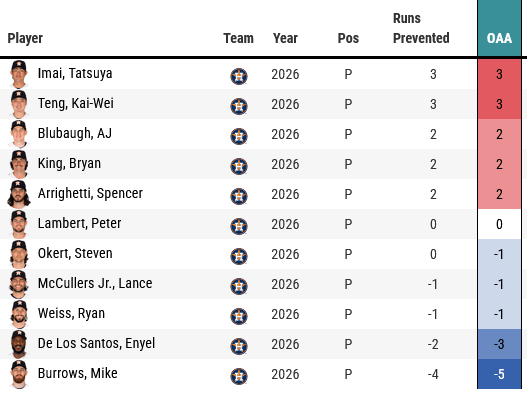
Tastuya Imai has enjoyed a notable turnaround in his performance, and he has also received the best defense behind him (+3). Kai-Wei Teng received equally good OAA (+3), and has pitched well during this period. A.J. Blubaugh, Bryan King, and Spencer Arrighetti also were rewarded with good fielding efforts behind them. Mike Burrows, who allowed the current pitching roster’s highest Batting Average on Ball in Play (BABIP) had the worst defense behind him (-5 OAA). I suspect that it’s not coincidental that Burrows’ BABIP is an elevated .321 and the fielding behind him is -5.
As the Astros try to rebound from their poor start to the season and seek to improve their standing in the AL West, continued improvement in their defensive performance will be critical. The overall team run prevention is a combination of pitching performance and fielding effort.
Feature photo from @astros on X, Source Link (cropped).