So far this season, we know that the pitching has been the Astros’ Achilles Heel. We also know that the inability to throw enough strikes, and the resultant walks, are a huge part of the pitching issues.
But there is another element of this problem which isn’t caused by the pitchers but results from a leaky defense. Weak fielding inflates the runs allowed by the team. Part of the fielding weakness is associated with injuries (particularly in the outfield). While admittedly the pitchers themselves may be largely responsible for a league worst ERA, the cumulative impact of fielding problems also contributes the high ERA. To be clear, we aren’t talking about errors, but rather sub-par fielding which could be caused by poor positioning, insufficient range, weak pitch framing by catchers and inadequate throws. The two primary defensive measures are Statcast’s Outs Above Average (OAA) and the Fielding Bible’s Defensive Runs Saved (DRS).
Perhaps a glimmer of hope is that this is a small sample size. Poor fielding data has time to regress to better numbers, since we are only about one-fifth of the way through the season.
The Astros rank 30th in ERA at 6.08. Those are terrible results. But the results are 0.79 runs better if Fielding Independent Pitching (FIP) is used. The FIP of 5.29 excludes batted ball data except for HRs; the poor FIP result, therefore, is largely due to home runs and walks, but the 0.79 variance from ERA essentially reflects the exclusion of bad BABIP (batting average on balls in play) results. The Astros rank relatively better on x-ERA, which is 4.55 (ranked 22d). The x-ERA result is 1.53 runs better than the ERA. The expected ERA (x-ERA) reflects some combination of fielding proficiency, positioning, ballpark quirks, and the broad but misleading category called “luck.”
Baseball-Reference.com calculates the impact of below average difference on the team’s runs allowed pitching. According to the current calculation, the Astros’ runs allowed per 9 innings is inflated by 0.13 runs due to below average defense. This implies that 17% of the difference between the Astros FIP and its ERA is due to poor fielding. If one assumes that the B-Ref defensive impact data is correct, this implies that 8% of the difference between the team’s x-ERA and actual ERA is due to inadequate defense. To sum up this comparison, a large part of the variance (80% – 90%) between ERA vs. FIP or x-ERA falls under the rubric of “luck,” but a notable portion of the difference is likely due to bad defense.
So far this season, both advanced defensive metrics rank the Astros well below average. The Astros are tied with Miami at 29th in defensive runs saved at -8. By comparison, the Dodgers and Red Sox are 1 and 2 in DRS with +25 and +23. The Astros are ranked 26th in OAA at -6.
According to Baseball-Reference, DRS ranks Carlos Correa as the best defensive player so far (+3). Based on current results, DRS ranks Christian Vasquez, Christian Walker, and Cam Smith as the team’s other above average defensive players. DRS gives noticeably poor results (-2 to -3) to the following regular position players: Jose Altuve, Jeremy Pena, Yainer Diaz, Yordan Alvarez, and Isaac Paredes. Joey Loperfido, Brice Matthews, and Jake Meyers clock in at zero DRS so far. But the tiny sample size negative DRS for some of the replacement outfielders would indicate that the Astros’ defense suffers from the loss of Meyers and Loperfido to injury.
OAA sees some of the individual player defense differently. Cam Smith is ranked the best defender (+4), with Correa, Vasquez, Walker, Paredes and Loperfido ranked as positive defenders so far. The remaining OAA results are directionally similar to DRS.
The catcher tandem of Diaz and Vazquez provide an interesting contrast of good and bad on the defensive side. According to DRS, Vazquez is the Astros’ second best defensive player and Diaz is the Astros’ worst defensive player. That B-Ref defensive page shows extrapolated results if the current defensive trend were expanded to 135 games. Those extrapolations are hypothetical, but they indicate an annual DRS of -21 for Diaz and + 22 for Vazquez. While all kinds of small sample size caveats apply, this would suggest that the Astros would gain defensive runs saved by starting Vazquez more often and Diaz less often at catcher.
While the pitchers themselves have much work to do in order to improve their ERA, the defensive results suggest that it is not all their fault. The team defense needs to improve in order to ensure that more batted balls are converted to outs. Run prevention is a function of both position player fielding and pitcher skill. And to this point, the Astros defense has compounded the lack of run prevention by the pitchers.
As noted previously, given that the largest part of the season remains to be played, there is time for the team defense to regress to better results. Advanced defensive metrics are particularly noisy stats, making regression probable. Moreover, the return of outfielder Loperfido and Meyers would stabilize fielding results in CF and LF. Pena did not have good defensive results before his injury, but he is a former Gold Glover and should improve both his individual fielding and team fielding when he returns from injury.
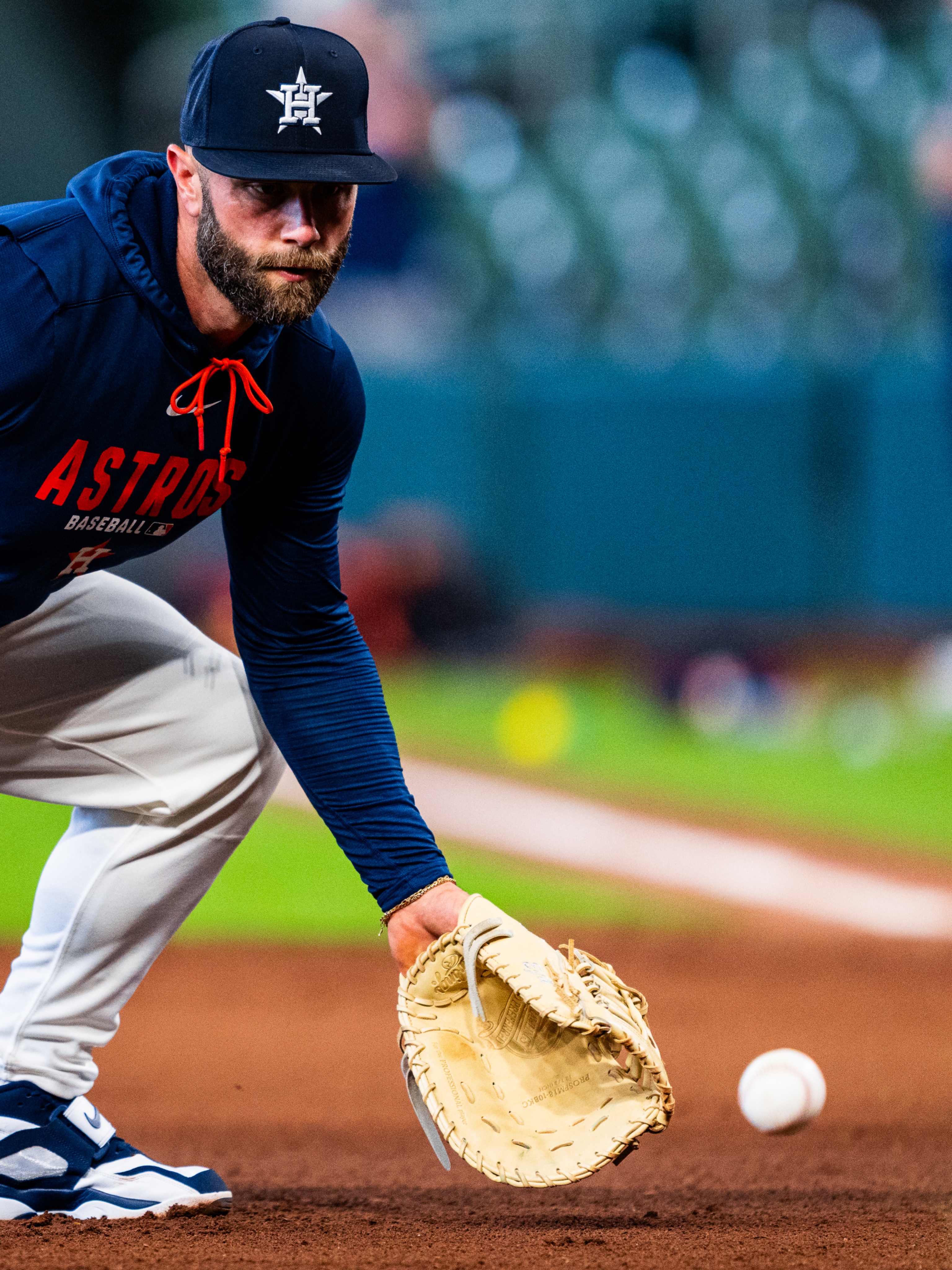
Feature photo from Astros on X, Source Link

































What this seems to indicate is that, once again, the Astros have experienced a perfect storm of issues to begin a season. It’s not like the team is filled with terrible defenders, although Yainer at C is a glaring issue if his defensive woes don’t improve. But aside from one or two very notable things that I won’t speak into existence by mentioning, once again, nearly everything that could go wrong, has. At least in certain facets of the team and certain areas of injury (and mental?) problems.
While I still firmly believe Brown and Espada’s days are and should be numbered here, I don’t think Dana Brown built a “worst in history” staff. He just did not account for what might happen if everything went wrong on the run-prevention side of the team- injuries, underperformances, poor adaptation from new pitchers and from old pitcher to new rules. It’s been death by a thousand cuts.
“For pure defensive value (framing + arm), Christian Vázquez has the best established profile, but for a combination of age, potential improvement, and current defensive ability, Yainer Diaz is generally considered the better overall option, despite his struggles with framing, as he is significantly better at controlling the running game than Caratini.”
this quote is from…?
— RAGTIME
Nope. Google AI
Gemini
Send Yanier a farewell package. Got it. Fairly early in the year for some of our better players to get from 0DRS to +DRS. But yes, Yanier finds new and interesting ways to be bad and hurt us.
Don’t put all your faith on defensive metrics. Yainer’s BA is similar to Paredes’.
Yeah don’t look now but Yainer has a 9 game hit streak going
I would be fairly curious if you moved Diaz to 1B and let him focus on hit at bats more often if he would see sustained improvement in him.
Until and unless Diaz accepts that he needs more patience and plate discipline, position moves will have no impact on his batting. Back in 2024, I said Diaz HAS to improve his plate discipline such that he will take walks and pitchers know they need to make pitches in the zone, or else he would be out of baseball in 2 – 3 years. I said that because history tells us batters do not survive long if they have miniscule BB% and high chase rates. Later I felt that I was being harsh. But right now, I feel like it was probably a correct call. It’s up to him to change his whole approach at the plate.