The Houston Astros are blessed (cursed) with their membership in the American League West. The AL West has zero teams with positive run differential, and four of the other five divisions are blessed with three such teams. The only exception is the AL Central, with two, and one of those teams is the Detroit Tigers, currently 12 games below .500.
To wit, there are 18 teams with a better pythagorean record than the Astros have. A lot of that shame, it should be noted, is directly attributable to Houston’s ridiculous 19-30 start (they’re 54-41 since, not a world-beater by any measure, but, pretty good-ish, right?)
Still though, the Astros post-mid-May success should be (may be?) the benchmark by which we measure their possible post-season success. A lot of Houston’s early-season pain and misery could be directly attributed to their unremarkable, underwhelming, and entirely forgettable bullpen performance through the first 50-ish games of the campaign.
Since those first 50 games? Yeah.
In the 250 relief innings pitched since that arbitrary May 19 cutoff, the Astros bullpen has limited opponents to a nearly 4:1 K:BB and a 1.05 WHIP.
The high-leverage core was substantially even better than that in August: Bryan Abreu, Josh Hader, Steven Okert, AJ Blubaugh and Enyel De Los Santos combined for a 1.06 ERA in 59⅓ innings.
Beginning May 25, the Astros bullpen has posted a major-league-best 2.63 ERA over 250 innings, with a 27.5% strikeout rate and 7.7% walk rate.
Bryan Abreu, in particular, has been key, maybe even the symbol for recovery as regards the Astros bullpen. Starting on June 4th (and yes, I can be accused of cherry-picking, but fuck you), Abreu has a WHIP just north of one, an ERA of 1.47, and an opposing batting average of .141. So yeah, he’s walked about five batters per nine innings during that span, but hey, pobody’s perfect.
AJ Blubaugh is far and away the most prolific relief pitcher in the entire major leagues, and it’s not even close. Blu has pitched 86 1/3 innings so far, and that’s 11 1/3 innings more than the second place pitcher, Paul Blackburn of the New York Yankees. Despite Blubaugh’s heavy workload, he’s struck out over a batter per inning, limited opponents to an ERA just north of three, and ranks third on the team in innings pitched, behind only Mike Burrows 94 2/3 innings and Peter Lambert’s untouchable 139 2/3 frames. And he’s a reliever.
In closing, maybe consider AJ Blubaugh as the Houston Astros unsung MVP of the 2026 campaign thus far, and maybe also consider forgiving Bryan Abreu’s unholy start to the season. I think the man doth come around.
Also, Josh Hader has limited opponents to a .069 batting average (nice). nuff said.
Astros @ Phillies Games Information and Gamethread Details
The Astros (73-71) begin a 3 game road series with the Philadelphia Phillies (81-63) still in first place by 2 games, despite dropping the last 2 games of their home Arizona series. The Phillies are in second place in the NL east, trying to chase down the Braves who are 4 games up on the Phillies with 18 games left in the season.
Hayden Wesneski starts for the Astros, coming off his best start of the season, and probably career, against the White Sox on September 2, throwing 7 innings of 1-hit shutout ball, striking out 5 and walking 2, in a 2-0 win. Through 7 starts, Wesneski is 4-1 with a 3.18 ERA, 1.06 WHIP, despite a career low 7.5 K/9 and career high 3.2 BB/9.
Andrew Painter starts for the Phillies. Painter is a 6’7″ hard-throwing 23-year old right handed rookie, who averages 96.5 mph on his 4-seamer and has gotten his fastball up to 98.7 mph this season. In 21 games, 19 starts, Painter is 3-8 with a 5.55 ERA, 1.37 WHIP, with a 7.8 K/9 and 3.2 BB/9.
Painter had just as strong a start as Wesneski his last time out, also going 7 innings of shutout ball against Arizona, limiting the Diamondbacks to 2 hits, no walks, and striking out 6. Unfortunately, Painter received no run support, and the Phillies would lose 1-0, after the bullpen gave up the only run of the game.

The game will be broadcast at 5:40 p.m. CT on SCHN with radio coverage on KBME 790 AM.
This post will be updated with starting lineup as they are made available.
We hope you will join us and the rest of the Launch Angle community for the game! The turnout has been amazing on the TLA Discord Server for the game threads.
Join us again for today’s game. Just join the Discord server using this link: https://launch-angle.com/discord .
For more detailed instructions, please see the Guide to the Launch Angle.
If you’ve participated in game threads on other Astros sites in the past, you will probably see a lot of familiar names. Chat, lurk, do whatever! (But please say “hi”, so we know you’re not a bot.)
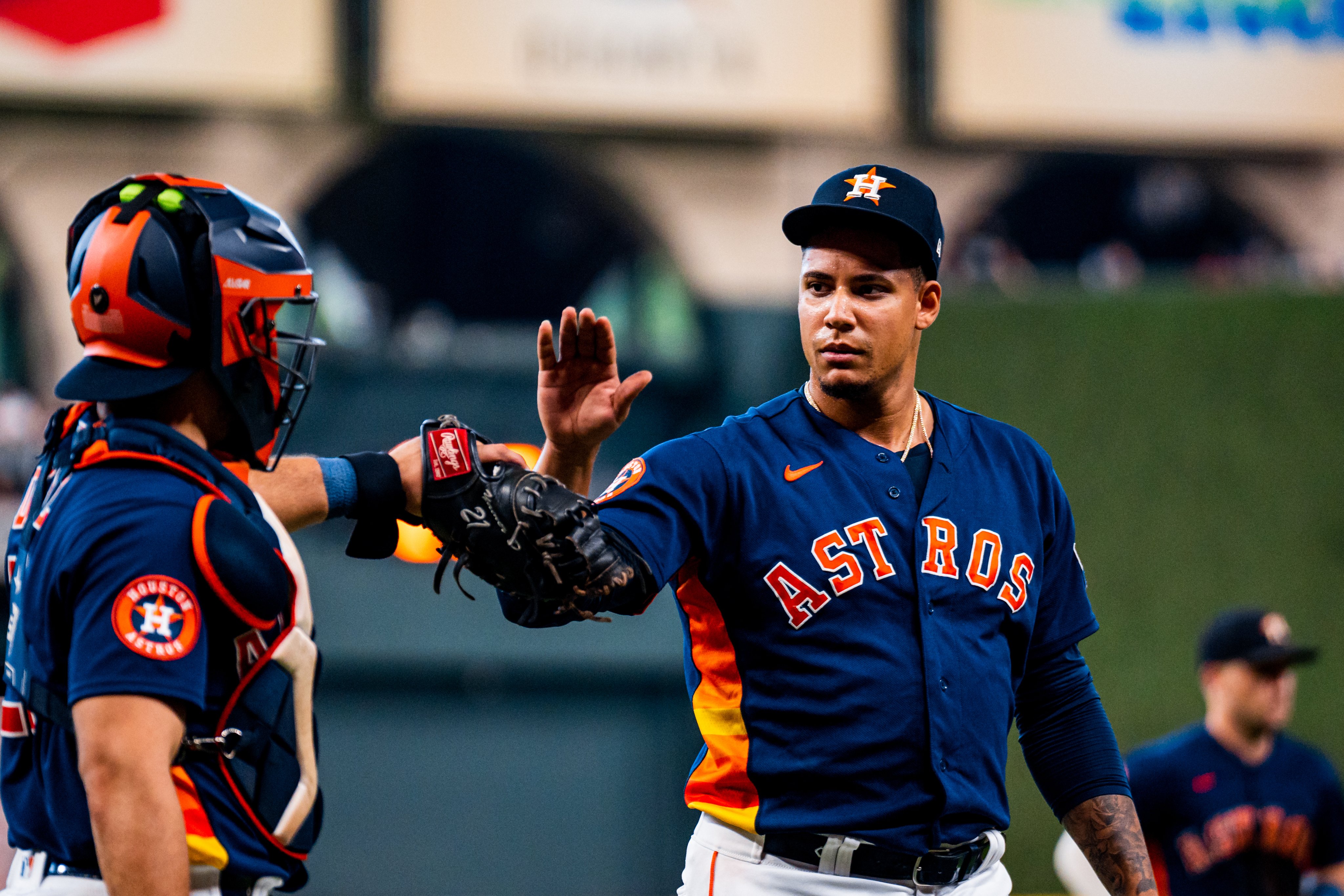
Feature photo from @astros on X, Source Link.




Since the Pythagorean performance (and the related Run Differential stat) are discussed, it’s worth mentioning that the Detroit Tigers are on track for one of the worst Pythag under performance in recent history. Fangraphs analyzes the “why?” And the Tigers’ example encompasses the full range of reasons that teams over or under perform their Pythagorean Record. First, terrible performance in one run games. Second, related to the first, is that the late game relievers have been bad (Jansen and Finnegan). Third, poor sequencing of offense (i.e., poor high leverage batting performance)
Some of these factors apply to the Astros’ over performance of Pythag. With the second half return of Hader and improvement of Abreu, the leveraged relief has been quite good. The Astros offense has been quite good at scoring with two outs, which provides unexpectedly good sequencing.
I would also note that the SF Giants are on track to historically under perform their BaseRuns, which is a more complicated version of Pythag that uses estimations of how many runs should have been scored given the number of base runners. I won’t go over all of the analysis, but it seems that the Giants’ offense is on track to have the lowest rate of walks in the post-integration history of the MLB. (Before the season started, GM Buster Posey indicated that he didn’t believe walks were all that important.)
Did Posey really say that? Yikes.
Posey’s response in May as to why the walk rate was down
Is this what was being referred to?
Before the season, Posey laid out his vision of what the SF offensive identity should be. He wanted the primary mission to be putting the ball in play and making contact. He felt that modern hitting philosophy over emphasized launch angle and exit velocity. That is one reason he signed Arraez (who has since been traded at the deadline). The ball-in-play emphasis leads to fewer pitches taken and fewer walks.
Interesting to see other teams trying to BABIP their way into runs but with analytics rather than opposed to it (Rays and Brewers come to mind)