
The Astros are in 1st place in the AL West, but the offense hasn’t been robust so far during August. If you visit the game thread on Discord, you will see continual complaining about excessive first pitch swinging and hitters’ lack of patience. (Not that this is unusual in game threads, where fans’ hot takes are expected.)
The Astros faced good pitching this past weekend in losing 2 of 3 games vs. the Mariners. On Friday, the Astros batted in three innings seeing 10 or fewer pitches. On Saturday, the Astros batted in four innings seeing 10 or fewer pitches. Then, on Sunday the Astros batted in five innings with 9 or fewer pitches seen. Impatient hitting? It appears so. On Sunday’s national broadcast, the announcing crew suggested that the Astros have an overly aggressive approach to batting.
So, let’s review the Astros batting patience this season. The Astros offense this season is basically average in the number of pitches taken per plate appearance (Astros P/PA is 3.87 vs. league average of 3.87). However, the Astros have a significant number of hitters who are worse than average, as shown by this table from Baseball-Reference.com.
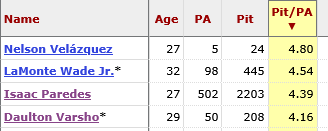
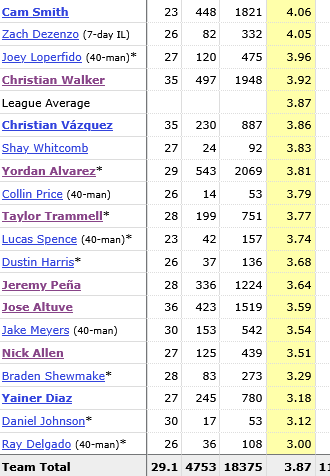
Among current starters, Lamonte Wade Jr., Isaac Paredes, Cam Smith, Daulton Varsho, and Christian Walker are above average in number of pitches per plate appearance. Notably, the in-season additions (Wade and Varsho) are hitters who see more pitches. So, it appears that GM Dana Brown may have prioritized this hitting characteristic. Yordan Alvarez is right around league average in seeing pitches. However, Taylor Trammel, Jeremy Pena, Jose Altuve, Nick Allen, and Yainer Diaz are below average in the number of pitchers seen. Diaz at 3.18 P/PA frankly exercises poor plate discipline and patience.
Although the Astros P/PA is league average, that outcome is a considerable improvement over the previous season when the Astros ranked dead last in seeing pitches per plate appearance. I think the changes to the hitting coach staff over the off-season occurred in part because the Astros approach was too impatient.
Another marker for plate patience is first pitch swinging. Admittedly, sometimes first pitch swinging brings good results if the hitter can ambush an expected fastball. And we have seen occasions this season when Pena, Alvarez, or Altuve hit a first pitch home run. However, in general, first pitch swinging tends to be an indicator of more impatient hitting. Hitters with elite plate discipline, such as Juan Soto, can go for long periods of time without swinging at a first pitch. So, thoughtfully targeted first pitch swings are not necessarily bad. But frequent first pitch swings often accompany poor plate discipline, and if multiple hitters swing first pitch in a game, it may prevent the team from getting into the opposing team’s bullpen earlier than usual. The league average for first pitch swinging is 32.5%. Two Astros hitters are very good at avoiding first pitch swings–Lamonte Wade Jr. and Isaac Paredes, with Paredes at 16% and Wade at 19%. Christian Vazquez and Yordan Alvarez are above average at controlling first pitch swing percentages (26% and 32%, respectively). The remaining Astros are below average at minimizing first pitch swings. Yainer Diaz, Jose Altuve, and Jeremy Pena are the most frequent first pitch swingers at over 40%. Pena’s first pitch swinging is almost 50%.
Another measure of patience is how many times the hitter sees a 3-0 count. Of course, factors other than patience, such as the hitter’s place in the batting order and the perceived danger they pose to opposing pitchers, also influence the number of 3-0 counts seen. But one of the reasons for patience is to put the batter in “hitter’s counts” and 3-0 is the ultimate hitter’s count. On average, league hitters see 3-0 counts 4.4% of the time. Yordan Alvarez and LaMonte Wade Jr. are very good at getting the count to 3-0 (over 10% and 9% respectively). Several are above average at seeing 3-0 pitches (4.5% – 6.5%): Varsho, Walker, Paredes, Allen, and Smith. The remainder are below average, with Pena, Vazquez, and Diaz hardly every seeing 3-0 counts (3% or less).
As measured by wRC+, the Astros’ offense in August has been somewhat worse than it was in the first half of the season (100 wRC+ vs. 104 wRC+). However, some measures we might view as process related have been better in August, in particular BB% and K%. The Astros’ walk rate and strike out rate have been quite good in August (9.2% BB and 18.6% K). To some extent this may reflect the in-season addition of high contact/high walk rate players like LaMonte Wade, Jr. and the assignment of high K rate players like Zach Dezenzo and Joey Loperfido to AAA. But the main reason for the lower wRC+ in August is fewer extra base hits. The Astros’ ISO in August so far (.146) is 0.03 lower than the ISO in the second half. In my view, greater patience at the plate might permit the Astros hitters to see more of “their” pitches, which can be drilled for extra bases.
As discussed previously, the Astros’ revamped their hitting coach personnel in hopes of improving deficiencies. One of the key actors in that revamped staff was Dan Hennigan who was expected to modernize the integration of data used by players for game preparation. But Hennigan left to take a coach job at Wake Forest, and his last day was August 2, which coincides with the perceived hitting issues this month. Chandler Rome at the Athletic discussed Hennigan’s departure:
In his role as offensive coordinator, Hennigan has spearheaded the Astros’ pre-series preparation, working alongside advance scouting coordinator Ricardo Lizarraga to compile copious amounts of data that is sent to the team’s group chat each night.
“The info is good,” Walker said in April. “It’s efficient. We’re not getting overloaded. We talked a lot during spring (training) about ‘What do you need to see before a game?’ I think what we’re getting is just a blend of all this information.”
Hennigan’s initial job description did not include him being in uniform or in the dugout during games, but input from both Espada and players altered that. He has accompanied the team on almost every road trip and is a fixture in the dugout during games.
(The player quoted above is Christian Walker.) We don’t know how the change in fulfilling this data compilation and game planning role actually affected the team. Presumably, the necessary duties are being fulfilled by others on the coaching staff. But there is no way for us to know if the game plan preparation by the hitters was disturbed in some way. And it’s natural for fans to wonder whether Henngian’s departure had any relationship to the subsequent offensive lull in August.
Another issue affecting August is the mid-season trade acquisition of Daulton Varsho on August 3. Varsho has gotten off to a slow start (6 hits, 1 HR in 12 games). This is one of the risks of trading at mid-season, and we have seen players acquired at mid season in the past (e.g., Sanchez, Mancini) experience a downturn. (It’s not hard to understand that players are undergoing a major change in their life, moving to another city on a moment’s notice.) However, Varsho has experienced some bad BABIP luck so far, and it’s very possible that he may regress to his more normal batting stats. His BABIP so far (.156) is 110 points lower than his normal BABIP. His exit velocity has been quite good (92 mph compared to the Astros average EV of 86 mph), but batted balls have been hit into opposing gloves. Varsho’s bat speed is higher so far than it was in Toronto (73.4 vs. 72.9). So there is certainly reason to believe that he will make a greater offensive contribution in the future.
The Fangraphs projections for Varsho’s “rest of season” range from .702 – .722 OPS, which would be a respectable contribution to the offense.
Will the Astros’ impatience at the plate persist, or will the batters take control of the strike zone with grinding at bats over the remaining games? That could well be a major factor deciding whether the Astros win the AL West.
Feature photo from @astros on X, Source Link. (cropped)


































Speaking of advance reports made for players, this is on the pitching side but Pat Neshek has been sharing some of his old ones on Instagram, which I thought were cool. Here’s one against the Padres
Good information.
Swinging at the first pitch is a choice. Espada can “order” JP3 and Yainer not to swing at the first pitch the two first at bat. The benefits are obvious and everybody would understand the “order.” After that, you can implement a strategy. Otherwise, the manager is a Chinese vase decorating the dugout.
So many ‘maths’ to ponder. I only perceive the eyesore test, and so plz pass around the Visine 👁