Mathematically, the Astros reached the true midpoint of their 2026 season on June 23 against the Blue Jays. Their 81st game ended with Houston scoring three runs in the 11th inning to pull out a victory that had looked far from certain just a couple of innings earlier. By that measure, the season is now closer to 60% complete than halfway finished. Still, that’s a small quibble on my end. The All-Star break, in all honesty, is the cleanest dividing line between the two halves.
But no matter how one slices it, the 47-51 Astros have largely been a disappointment. Only seven clubs have posted a worse run differential than Houston’s -47 runs—with Yordan Alvarez producing at an MVP level as a hitter. That’s kind of wild to me. If it weren’t for the mediocrity in the AL West, this team would already be written off in almost every other division, perhaps except the AL Central.

So, where does the fault lie?
There is certainly no shortage of options for assigning blame. Dana Brown’s roster-construction decisions come to mind. The age of the roster. Reading the tea leaves, Jim Crane’s possible payroll constraints throughout the offseason into this first half stand out. Once again, injuries matter. Underperformance from some of the highest-earning players on this roster, particularly among the starting rotation. Lack of quality reinforcements from the farm system. Honestly, it is all of those factors.
I do find myself asking, how would this season change if the pitching staff were closer to average or even slightly above average? To me, that’s the overarching issue behind this whole season to date. As constructed, this is one of the worst pitching staffs in baseball, with only the A’s and Nationals receiving less value than the Astros. When you narrow it down to only the starters, the situation doesn’t improve, with Houston sandwiched between two teams that play in hitter-friendly home parks.

Although Framber Valdez hasn’t pitched well for the Tigers, the Astros were going to let him sign elsewhere regardless of his future performance. With that backdrop, it was on Dana Brown to patch up a rotation that was already thin in depth back in 2025. And he certainly made moves, even if we can only speculate about the extent of Jim Crane’s involvement in Tatsuya Imai’s signing. Regardless, the additions to the rotation have largely not panned out. Well, other than Peter Lambert, who has been arguably the most consistent starter on this team. But Imai, Mike Burrows, and Ryan Weiss, all acquired in the offseason with the intent to predominantly start, have largely disappointed (6.25 ERA/5.68 FIP in 172.2 innings). That trio has cost the Astros -0.7 wins. Yes, Hunter Brown’s injury and subsequent inconsistency since his return play a role. Cristian Javier, who signed an extension early in Dana Brown’s tenure, now hasn’t pitched well for multiple seasons. But when the majority of your offseason acquisitions, who the team is depending on to absorb important innings, can’t even perform around league average, well, it isn’t a good look.
Another aspect of Dana Brown’s roster-construction decisions that continues to confound me is the state of the outfield. For the second season in a row, we’ve seen an outfield filled with fourth- or fifth-outfielder-caliber options. The data reflects an outfield that is grossly underperforming compared to its peers, with only the Phillies receiving less value in 2026. And only two outfield groups have fared worse at the plate than the Astros.
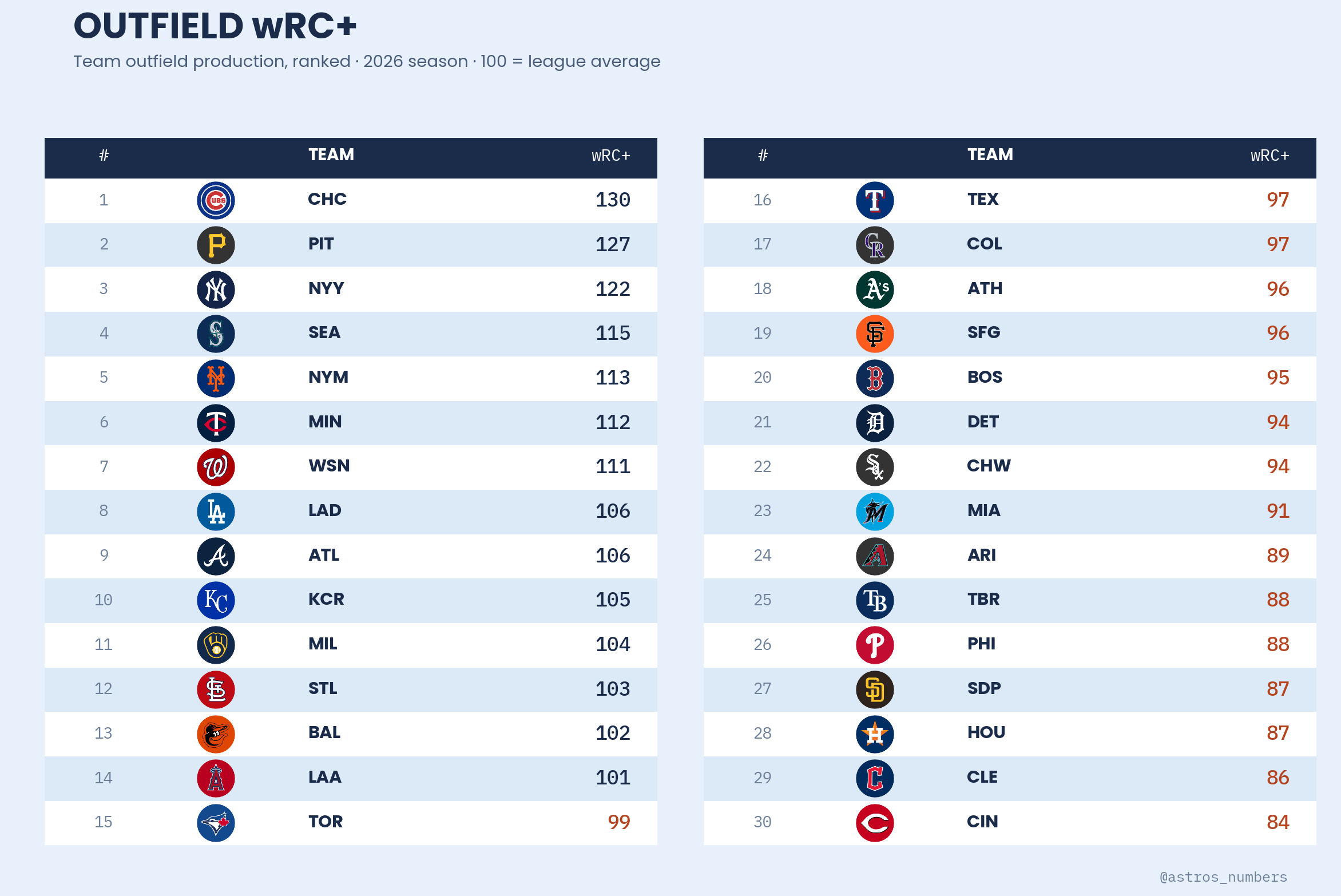
The one thing that Houston’s outfield does well is catch the ball. Cam Smith is a terrific defensive right fielder. Jake Meyers, even with his option to Sugar Land, is generally regarded as an above-average center fielder. Brice Matthews has really grown into an above-average outfielder, too. But quality defense only takes a team so far, especially if the overall offensive performance is already so poor. LaMonte Wade Jr., who joined the organization in June, is the only outfielder not named Yordan Alvarez to have at least 30 plate appearances and a wRC+ above 100, or league average. Taylor Trammell is next with an 89 wRC+.
So much for not being done yet.
All that said, not everything that has gone wrong is Dana Brown’s fault. I mean, he didn’t sign Lance McCullers Jr. to an extension that hadn’t aged well either. The farm system was well in decline before his arrival, and he works for an owner in Crane who wants to keep the competitive window open. He was hampered by the contracts Crane had given to Rafael Montero and José Abreu prior to his hiring. There are expectations baked into his job that he can’t change. And, generally speaking, he has a quality eye for talent. This year’s draft decisions appear to have been well received in the industry thus far, albeit way too early to properly assess. The pitching staff, in particular, has benefited in the past from some of his acquisitions and decisions. If certain injuries didn’t occur when they did, namely to Ronel Blanco, Hayden Wesneski, Luis Garcia, and José Urquidy, in the past several seasons, this rotation looks and likely performs differently.
But what we’re seeing with the Astros is the natural life cycle of a team not named the Dodgers or Yankees. For numerous years, this organization contended for pennants and World Series, which they definitely accomplished. Sooner or later, though, the Astros were bound to decline, especially with an aging roster and a farm system lacking reinforcements. There isn’t an easy way to fix these issues in the short term. If I were to take anything from this first half, it would be that this team isn’t good or bad but stuck in the middle. Barring a sudden reversal, I don’t predict my mind changing. The second half of the 2026 season will likely feature more of the same results, with the postseason out of reach.
Feature photo from Astros on X

































You are very nice to Crane. The organization is a big mess.
I don’t think there is anything natural or inevitable about the post-2023 decline. The irony is that the lack of a farm has only just now begun to hurt us- right at the moment when the farm is beginning to build up again into a valuable one at the lower levels- because of both Click and Brown’s ability to parlay less valuable prospects into usable talent, and salvage/scout talent from the waiver wire, offseason trades, and so on.
Brown over his tenure has generally made the roster younger as well, besides the disaster contract of Jose Abreu and the okay contract of Walker. Paredes is younger than Bregman. Cam is younger than Tucker. Burrows and Imai are young than Framber. Yordan and Pena are in their primes, and Altuve is the only long termer who is over 35.
Our issue, far more than youth, has been seeing the true effects of Lunhow’s final poor drafts, Click’s scandal-hobbled drafts and Crane’s rash of small bad contracts coming to a head all at the same time. It happened about two years too early, and two or three years before it should have. With our level of sustained spending, it was 100% possible to continue to field a strong team through the end of Altuve’s career, and to see a youth movement take over around 2029 or so as the farm was rebuilt.
Well, the farm is being rebuilt, visible already in the lower levels, but we’re a couple of years away from seeing any talent reach us without being rushed, and we’re SOL in that interim without seeing intelligent investment of the funds saved by bad contracts expiring.
That was neither natural nor necessary. Retaining hitting coaches who oversaw underperforming bats for two years too long wasn’t necessary. Refusing to go scorched Earth on training staff and procedures which have seen a very high injury rate and dubious recovery and reporting for several years was not necessary. And so on.
These past three years could have been either a little better or much better than they have been. But in our league and our division, even a little better sees us make the ALDS in 2024, the postseason last year and likely this year as well. Marginal issues matter.
Well said. It has been a struggle to see our window, our dynasty end because of ineptitude T the managerial level and front office. That is what killed the golden age. And that’s sad.