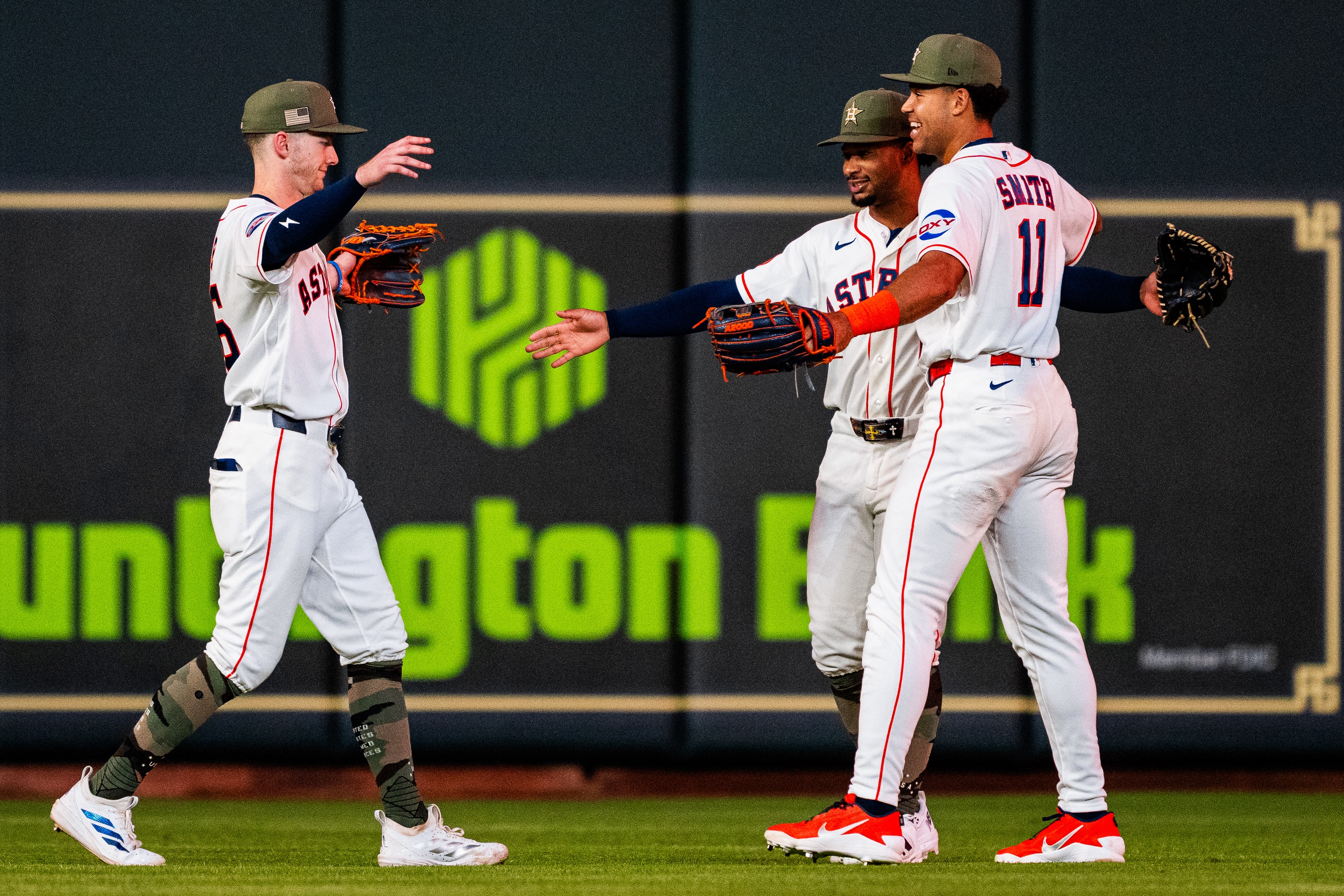
As the Astros’ injuries pile up, the offense has slowed down. And it’s not surprising when you examine daily lineups. The lineup is more top heavy now, with heavier reliance on a veteran core at the top of the order, and “hoping for” production from the bottom five positions in the lineup which is generally held together by rookies and Quad-A hitters. Four rookie outfielders are a big part of this story.
I will focus on assessing four rookies– Zach Cole, Zach Dezenzo, Brice Matthews and Cam Smith (who’s no longer technically a rookie, but still at a similar point in his career). All four play the outfield, with Brice also playing some second base. These four are chosen for evaluation because I regard them as true prospects, as opposed to young players like Braden Shewmake and Shay Whitcomb who are aging out of prospect status. As prospects, the Astros felt the four players have the potential to become pieces of the Astros offense of the future. So we should have some fascination following these four players to guess at whom might succeed and who won’t.
It’s too early to reach many conclusions because the sample sizes are so small. But the offensive results have not been great so far. All four have batting averages ranging from .160 to .220 (with Smith and Matthews currently showing an identical .208 batting average), which contributes to fans feeling like the bottom of the order is a black hole. Frankly, if only one of the four were in the lineup, that wouldn’t be a problem. But when three of them are playing at the same time, it can feel like a drag on the batting order. As you know, batting average isn’t the best statistic to evaluate the future potential of offensive players. Underlying advanced stats are more accurate predictors, and we will look at some of those peripherals.
The following table utilizes Fangraphs stats:

An encouraging sign is that at least 3 of the 4 are hitting with high exit velocity. One of the best EV metrics is EV90, which eliminates some of the noise that affects a raw average exit velocity. League average EV90 is 104 mph, and Smith, Cole, and Matthews all have EV90 well above that level of hard hitting. So far Zach Dezenzo has an average EV90. Cole, in particular, has an EV90 that contributes to what would be a Top 20 Hard Hit % if he had a qualified number of at bats. Smith has qualified at bats, and his EV90 is ranked 30th among MLB hitters.
The batting averages are below .200 or in the low .200’s. However, the batting averages for Cam Smith and Zach Cole should be higher, based on expected stats, which reflect exit velocity and launch angle. Cam’s x-BA is a more respectable .242 and Cole’s x-BA is at least above .200. And Smith and Cole exhibit x-SLG which are substantially higher (over 100 points for Cam and 80 points for Cole) than their actual SLG. Cole’s x-SLG of .444 paints a picture of a power hitter and Cam’s x-SLG of .435 is respectable. The xwOBA shows a similar pattern for Cole and Smith. Making conclusions about Smith and Cole based on the recorded BA and SLG is not just premature but also potentially misleading. They have performed better than their numbers show, and there is a good possibility that both will experience reversion toward the expected numbers in the future.
A major part of the four’s offensive impediments is the inability to overcome swing and miss issues. The Fangraphs’ K% and BB% is shown below. The four have a K% ranging from 28% to 40%, which is fairly high and tends to cap batting potential due to lack of contact.
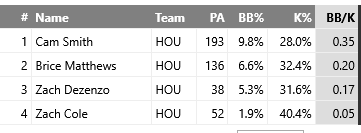
Hopefully Cole will begin to reduce his strike out rate soon because 40% will make it difficult to stay in the major leagues. Smith’s 28% is lowest among the four, but it is equally concerning, given that he has over one and third year’s experience. Cam exhibits a good walk rate and Brice’s walk rate is not poor and should improve with time, considering his double digit walk rates in the minors. Cole and Dezenzo have poor walk rates so far, but this may be an artifact of small sample size, given their history of better walk rates.
I also examined the Squared Up Explorer app on Fangraphs’ Lab page. Squared up rate measures good contact, and reflects the efficiency of the bat’s contact with the ball. The table below reflects the squared up rate for the four, separately for fly balls and ground balls.
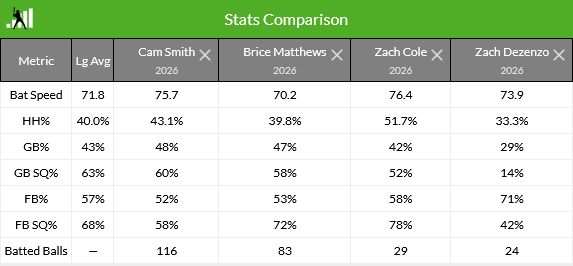
Smith, Cole, and Dezenzo have also exhibited well above average bat speed. Smith’s and Cole’s bat speed are elite, 98 percentile, with only about four MLB hitters posting higher bat speed (O’Neil Cruz, Junior Caminero, Walker Jordan, and Nick Kurtz). Cam Smith and Brice Matthews profile differently as ground ball hitters compared to Zach Cole and Zach Dezenzo who are fly ball oriented. Astros’ coaches would like to see Smith elevate the batted balls more but he continues to have an above average GB rate and he is also sub-par at squaring up grounders. At this point, Brice is better than Cam at squaring up fly balls with a 72% FB-SQ relative to league average at 68%. Smith, however, is below average (58%) at squaring up fly balls. Zach Cole is very good at squaring up fly balls (78%), but Zach Dezenzo is worst at doing so.
The Fangraphs’ comparison also provides some graphical detail regarding the relationship between the four players’ square up rate and launch angles. Generally speaking, squaring up the ball produces the most damage at launch angles between 20 and 35 degrees.

The batter would prefer a squared up rate in the rightward direction within the square that reflects a 25 – 35 degree launch angle. Lower launch angles are more likely to be singles or converted to an out. Higher launch angles are more likely to be lazy fly balls.
While exit velocity is important, it only tells part of the story. The ability to square up the fly balls in the 20 – 35 degree range reveals the potential for greater offensive results. Brice Matthews and Zach Cole have excelled at squaring up fly balls in the preferred launch angle for producing damage. Cam Smith has been less successful at squaring up the balls he has elevated into the preferred range. Zach Dezenzo has a small sample size, but he trails the others in squaring up the preferred launch angle batted balls.
Beyond the offensive results, defense and positional versatility is also important. The defensive component of fWAR is an indicator of defense as adjusted for positional value.
Smith and Matthews have been very good defensively at +3.6 and +1.5 defensive WAR respectively, while Cole and Dezenzo are closer to zero or negative in small sample sizes. In addition, Matthews has appealing versatility, playing LF, CF, and 2b.
Conclusion
The early sample sizes don’t provide sufficient basis to reach firm conclusions about the four hitters. They appear to be different types of players. Zach Cole profiles as the best power hitter, but until he reduces his K rate, we might expect him to become a low batting average, high HR power, 3TO (3 true outcomes) hitter. Cole, Dezenzo, and Smith all hit the ball hard but Dezenzo and Smith have shown some difficulty accessing their power. For Smith it’s a question of squaring up more of the balls that he elevates. Matthews, like Smith, hits a lot of ground balls, but he is better at elevating and squaring up balls into the preferred launch angles.
At some point in the future, the Astros have two outfielders (Taylor Trammel and Joey Loperfido) returning from the Injured List. How will that affect these four? That’s a good–and unanswered–question. It’s possible one or more of the four could be optioned to AAA. Given the results so far, Dezenzo, who has been given the fewest at bats, could be a candidate. Cam Smith bypassed AAA, and some might argue that he could use development time in AAA. However, his expected stats are quite favorable, and that, in combination with his defense, probably keeps him on the major league team. Brice’s defensive versatility may make his position safe. Cole has two factors in his favor–the best expected slugging ability and, in addition, hitting from the left side. Until the Astros decide to make a decision when Trammel and Loperfido return, all four of these young outfielders are likely to continue to get starting opportunities.
Feature photo from @astros on X, Source Link


































This is pretty much what I expected to happen. I’m not fan of prospects with all the tools who struggle to make contact. It is too early to give up all the way on any of them of course, but right now an outfield of Meyers, Loperfido, and Trammell looks like a huge upgrade.
I’d keep Cam in RF, Jake in CF. LF can be a mix of TT, Lopes and Brice, with TT and Lopes splitting work against RHP and Brice against LHP. TT, Lopes and Brice can also get playing time in spelling Jake and Cam and Brice also working in at 2B. I only would use Cam and Jake as everyday starters and not really “everyday” but more like 4 out of 5 days. And then Zach and Zach to aaa to work on their deficiencies at the moment
Really nice write up.
With Altuve on the shelf, even with Trammell and Loperfido coming back, Brice should still be able to find playing time with some second base time mixed in. One of both of the two Zachs seem like option possibilities, but seeing Cole and Cam with bat speeds only rivaled by guys like Caminero, ONeil and Kurtz is nice to see.
That last graphic though is like a Kandinsky painting. I’m having trouble reading it. What is it showing?
I’m mostly looking at the shaded area between 20 and 35 degree launch angle. Brice is putting a lot of his fly balls in that space and doing the best job of squaring them up (which means coming closest to the ideal EV for the launch angle). Cole is similar, but somewhat less frequent. When Cam Smith hits fly balls within those launch angles, he doesn’t square them up sufficiently. Smith is more likely to square up ground balls and low liners than he is fly balls.
Cole and Smith need to go to AAA. They never completed a full seasoning down a level and were rushed. Let’s give the youngsters the opportunity to become better.
This is the kind of detailed analysis I love to read.
The arguments over Smith and Matthews have been done and done elsewhere, so I’ll focus on Cole.
I think if Cole can reduce his K rate to 30% or below, he can be on an MLB roster as is, not counting any further improvements which you would naturally expect over months or years of MLB experience at his age. He has enough metrics working in his favor that overcoming his K rate Achille’s heel is pretty much all he needs to do. But it’s a big ask, a little like Pena’s very visible weakness towards breaking pitches away in 2023 and 2024. The question is whether ABs in AAA can help solve his strikeout issue.
Dezenzo just seems to me like a guy who has never had a chance to fully get his feet wet at the MLB level. His metrics and xstats are not as impressive as I would like, but I think he can improve. I would send him back to AAA first of the four, in favor of Trammel/Loperfido, who seem to be me be better defensively, more agile and have the advantage of batting from the left.
The easiest path when the aforementioned guys return is to send down Dezenzo and Cole. L/L/R/R balance would be achieved and you’d have more proven guys on the field. The eye test tells me to send Smith down, but the metrics say no. And I can see the logic of letting Cole return to AAA explicitly with the message to lower his K rate- *if* AAA is an environment where he can reasonably do that and have it translate to the MLB level.