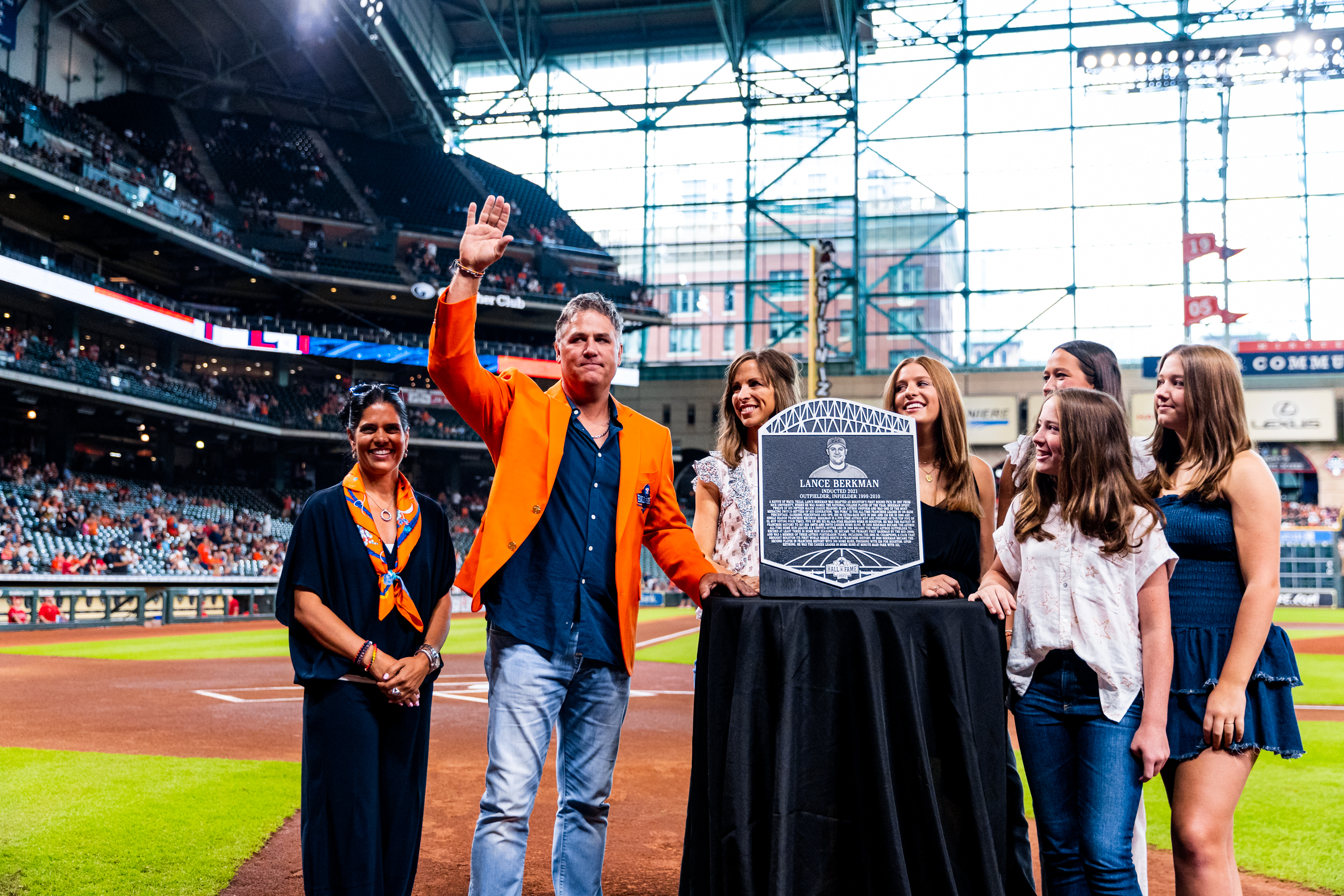
We are going to handle this one a little differently than we have handled the others. We are still picking the top two left fielders not in the Hall of Fame. Of course, like before we are eliminating those credibly accused of committing crimes or cheating. That leaves us with Lance Berkman and Bob Johnson.
Instead of leaving them on the bottom of the tables as we have done before, we are going to place them where they actually rank based on the different categories. As a reminder, we are looking at WAR seasons, real offensive value and bases per out, and total runs. We are looking at the nine left fielders that came within ten percent of the median in the index.
The idea is that these nine players represent the essence of who qualifies as a Hall of Famer. If these two are similar to these guys then they have a good case for getting into the Hall of Fame. We have naturally done some other tests including the index itself, playoff performance, and awards voting. These tests stand as additional tests.
LF WAR Seasons
| 5 WAR | 4 WAR | 3 WAR | Total | |
|---|---|---|---|---|
| Fred Clarke | 5 | 4 | 5 | 14 |
| Bob Johnson | 3 | 4 | 5 | 12 |
| Jesse Burkett | 5 | 3 | 3 | 11 |
| Goose Goslin | 7 | 0 | 3 | 10 |
| Billy Williams | 5 | 4 | 1 | 10 |
| Joe Medwick | 3 | 4 | 3 | 10 |
| Willie Stargell | 4 | 1 | 4 | 9 |
| Minnie Minoso | 6 | 2 | 1 | 9 |
| Joe Kelley | 4 | 2 | 3 | 9 |
| Lance Berkman | 5 | 1 | 3 | 9 |
| Zack Wheat | 3 | 3 | 1 | 7 |
I wish I could say I invented the concept of similarity scores, but sadly I didn’t. That was Bill James. The index is based on the concept of similarity scores. It combines the index itself with the idea of looking at offensive numbers, fielding numbers, awards voting, playoff performance, and these numbers. If you are similar to people that most people consider to be legitimate Hall of Famers than you probably are one too.
Bob Johnson already qualifies because he has more three plus WAR seasons than everyone except for Fred Clarke. When you throw in his American Association numbers you can see there is plenty of evidence to say he belongs. Lance Berkman is not as easy. You can say he is similar to Joe Kelley, Minnie Minoso, and Joe Medwick. Those guys are Hall of Famers, but they aren’t necessarily amongst the very best either.
These similarity scores work like an if…then statement. If these guys are in and Lance Berkman is similar to those players then he should also be in. Of course, that is also only one test. When we start to compile all of the tests we begin to get a clearer picture. Let’s see what happens when we compare Berkman and Johnson in terms of real offensive value (ROV) and bases per out (BPO).
LF ROV and BPO
| AVG | SEC | ROV | BPO | |
|---|---|---|---|---|
| Lance Berkman | 0.293 | 0.434 | 0.364 | 1.000 |
| Bob Johnson | 0.296 | 0.370 | 0.333 | 0.928 |
| Joe Kelley | 0.317 | 0.328 | 0.323 | 0.933 |
| Joe Medwick | 0.324 | 0.239 | 0.282 | 0.910 |
| Willie Stargell | 0.282 | 0.365 | 0.324 | 0.879 |
| Goose Goslin | 0.316 | 0.303 | 0.310 | 0.893 |
| Jesse Burkett | 0.338 | 0.276 | 0.307 | 0.927 |
| Fred Clarke | 0.312 | 0.278 | 0.295 | 0.851 |
| Minnie Minoso | 0.299 | 0.294 | 0.297 | 0.838 |
| Billy Williams | 0.290 | 0.318 | 0.304 | 0.829 |
| Zack Wheat | 0.317 | 0.219 | 0.268 | 0.779 |
Every metric measures something slightly different. So, ROV and BPO won’t align 100 percent, but they will be fairly close. Simply put, there are very few players with a 1.000 BPO in baseball history. Berkman is not only first in this group, but he is head and shoulders above them. Yes, he played in a good hitter’s era and a good hitter’s park, but it was utterly ridiculous for him to tumble off of the ballot after the first year.
Johnson slots in under him, but it is a pretty distant second place. Like Berkman, he played in a good hitter’s era. Still, he suffered due to only playing 12 seasons in the big leagues. Historians have to look at that era differently. It is the Baseball Hall of Fame and not the MLB Hall of Fame. He was a great baseball player in multiple leagues. Unfortunately, we do not have complete data on those American Association seasons.
If we believe baseball-reference.com then he hit .297 with a.485 slugging percentage. Unfortunately, those leagues did not accurately track walks. We could guess he had an OBP close to .400 and those 861 hits coupled with his 2051 major league hits and he has nearly 3000 professional hits. We just need an expanded understanding of the time period and the fact that he was held back through no fault of his own.
LF Total Runs
| RC | Rfield | Rbaser | Rpos | TR | |
|---|---|---|---|---|---|
| Goose Goslin | 1,664 | 50 | 9 | −101 | 1,622 |
| Billy Williams | 1,671 | −38 | 20 | −133 | 1,520 |
| Jesse Burkett | 1,565 | −4 | −20 | −123 | 1,418 |
| Zack Wheat | 1,481 | 54 | −7 | −116 | 1,412 |
| Fred Clarke | 1,393 | 91 | 7 | −124 | 1,367 |
| Joe Medwick | 1,391 | 45 | 8 | −86 | 1,358 |
| Lance Berkman | 1,475 | −17 | −24 | −85 | 1,349 |
| Willie Stargell | 1,531 | −70 | −13 | −107 | 1,341 |
| Bob Johnson | 1,364 | 18 | −1 | −77 | 1,304 |
| Minnie Minoso | 1,263 | 26 | 10 | −76 | 1,223 |
| Joe Kelley | 1,275 | 18 | 3 | −90 | 1,206 |
Johnson’s credentials have been hashed and rehashed. He actually is similar to Minoso for that reason. The idea of the index and similarity scores is to compare like players. Minoso and Johnson are similar in that they made later debuts. Minoso was held back by the color barrier where Johnson was held back by the absence an affiliated minor league system.
Berkman is similar to Willie Stargell, Joe Medwick, and Fred Clarke. If we were to compare him more directly to players of similar style then Stargell would be the more direct comparison. Both players played at first base and the corner outfield. Both players have some postseason success. Medwick is also similar, but less so.
So, the question comes down to whether you think Berkman and Stargell are really similar. We can look at the other tests to see how similar they actually were. Let’s take a look at the index, offensive numbers, fielding numbers, and awards voting. If they truly are similar then Berkman belongs in.
Willie Stargell: 120.6 career value, 97.3 peak value = 217.8 index
Lance Berkman: 107.9 career value, 98.2 peak value = 206.1 index
Stargell has a little bit of separation here and virtually all of it is on the career value ledger. You are looking at two seasons worth of production there. If Berkman had eleven seasons with three or more WAR instead of nine then he probably would be in now anyway. However, the index is not the only thing. Let’s take a look at offense.
Stargell: 147 OPS+, .717 OW%, .396 rOBA
Berkman: 144 OPS+, .719 OW%, .408 rOBA
When we couple these numbers with the bases per out and real offensive value we get a pretty clear picture. These numbers have mostly been sanitized for differences in era. We can see how similar these two actually are. We can look at both in a similar light.
Stargell: -70 Rfield, -22 total zone (LF only)
Berkman: -16 Rfield, +11 total zone (LF only)
Berkman is a better defender and played a couple of disastrous seasons in center field. Astros fans remember those years well. There was one particular catch on Tal’s Hill that is quite memorable, but the balance is that he just didn’t have the range to play center. The Cardinals used him in right field as well. If he stuck to just first base and left field he would have likely been a neutral defender. That makes him considerably better than Stargell.
Stargell: 38 MVP points, 16 BWAR points
Berkman: 27 MVP points, 16 BWAR points
One of the points of the awards test is to compare how a player fares in the MVP voting as compared to how he should have fared through WAR rankings. Both players were overrated according to BWAR. The difference is that Stargell has that MVP award in 1979. He was nowhere near the most valuable player in the league that season. That award probably pushes him past Berkman, but Berkman obviously has the exact same deserved rating. These are two very similar players.
Stargell: 153 plate appearances, .278/.359/.511, 7 HR, 18 Runs, 20 RBI
Berkman: 224 plate appearances, ..317/.417/.532, 9 HR, 38 Runs, 41 RBI
Stargell gets the reputation of being a part of the 1971 and 1979 World Series champion Pirates, but Berkman was the better postseason player. The Astros won the pennant in 2005 and the Cardinals won the World Series in 2011. He hit .423 in that World Series with a home run, nine runs, and five RBI. David Freese won the MVP for the World Series in spite of hitting only .348. It was his game winning home run that won the award.
Maybe if Berkman had been a part of a second World Series winning team or if he had been named the WS MVP as he should have been then the Hall of Fame voting might have gone differently. As it stands, they are similar enough that the voting should have gone differently. Hopefully, the Veterans Committee gives him a little more love.
Originally published in Thoughts from A Native Texan on April 12, 2026. Feature photo from @astros on X, Source Link.


































BERKMAN SHOULD BE IN