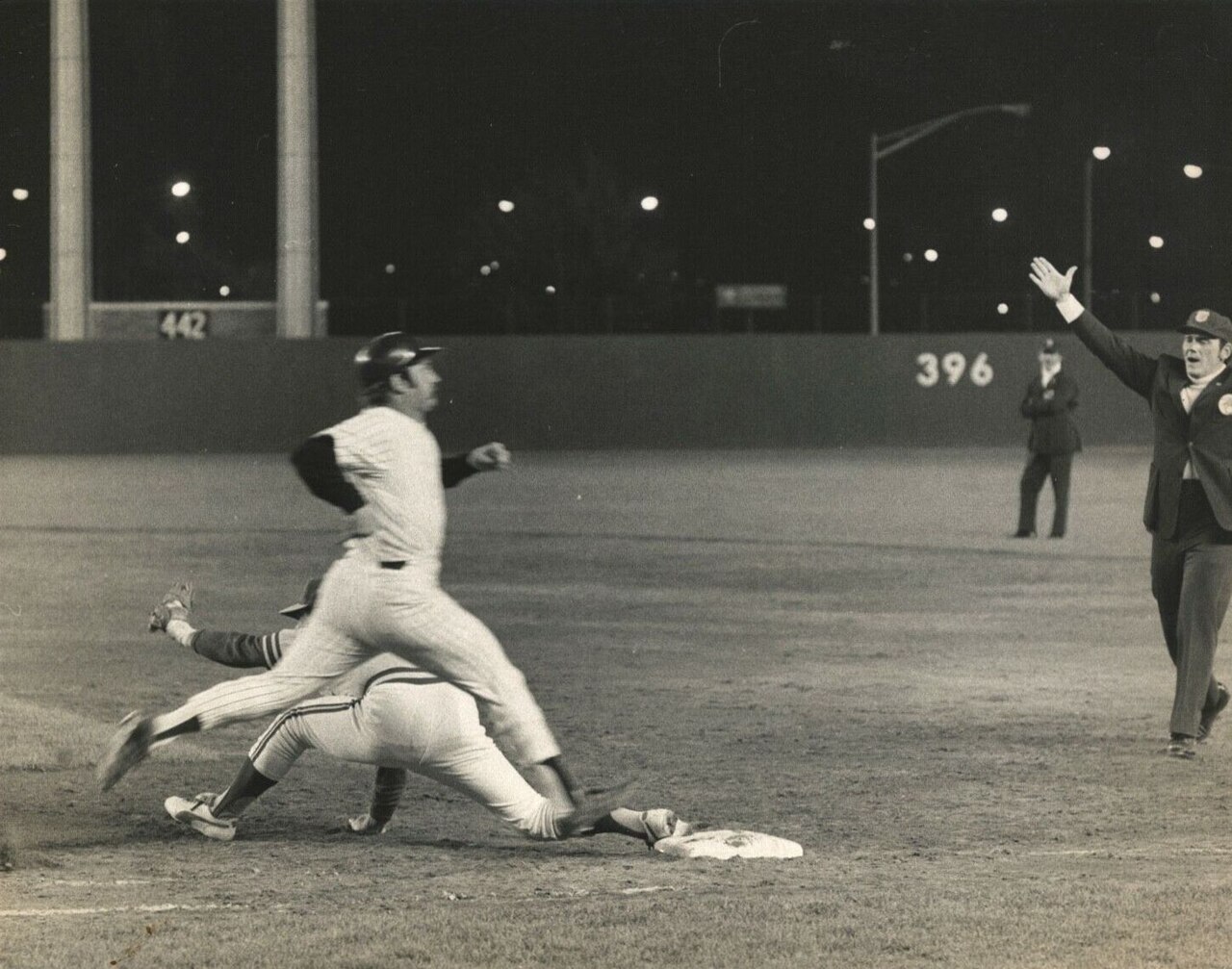
One of my favorite features in both Hall of Fame Index books are what I would lovingly call the “what about” series. I determined that Gene Tenace was the most qualified candidate at catcher amongst the Veterans Committee crowds which immediately would inspire people to ask, “What about Thurman Munson?” That happens to be a very good question at catcher. Unfortunately, some of those questions at other positions have caused problems.
It is a particularly good question at catcher because it asks us to deal with tragedy or other factors that are not normally part of the aging process. We have the same questions when dealing with the World War II generation or any other player that suddenly sees their career end because of unusual circumstances. Do we give them credit for years they did not have? Do we treat them like any other player? There really is no satisfying answer to that question.
As everyone reading this knows, Munson perished in a plane crash during the 1979 season. Those that want to add a little drama will say he was struck down during the prime of his career. That is a bit melodramatic. When you exclude his rookie season (which was a cup of coffee), his OPS+ in 1979 was the lowest of his career and the first full season that dipped under 100. It was his age 32 season. As we know, catchers don’t last as long as players at other positions, so he may have had only two or three full seasons left.
Furthermore, those weren’t going to be great seasons. The actuary table for catchers is pretty stark and shows that once they hit 30 they are not nearly as productive. What we can do is show the catcher tiers for wins above replacement per 120 games. It will be of interest because of where Munson finishes, but also where he might have finished with those additional three seasons.
Tier One Catchers
| Games | BWAR/120 | FWAR/120 | Index/120 | |
|---|---|---|---|---|
| Josh Gibson | 638 | 7.70 | 8.40 | 16.10 |
| Buck Ewing | 1,315 | 4.40 | 4.40 | 8.80 |
| Buster Posey | 1,371 | 3.90 | 5.00 | 8.90 |
| Mickey Cochrane | 1,482 | 4.00 | 4.10 | 8.10 |
| Johnny Bench | 2,158 | 4.20 | 4.20 | 8.40 |
I spend most of my working hours as an English teacher. This is one area where diction and complex statistics come together. We have to be precise in our language. This is a table that measures value. Being the most valuable catcher is not the same thing as being the greatest catcher. The term “greatest” is a subjective term and that is usually one settled over a beer at a sports bar. It includes the strength of the era, quality of the competition, and other accomplishments that are not related to the numbers above.
This is also only one table and one way of looking at value. A Buster Posey’s career was relatively short, so it is hard to look at his numbers and the numbers for say Johnny Bench and immediately claim Posey was better. Those extra 700 games mean something and create a context that we would have to view the numbers through. In other words, no single table proves anything. It is merely one piece of evidence we can use in our discussion.
I included Josh Gibson because it seems criminal not to. However, it is difficult to interpret his numbers. The seasons were so short and the level of competition was inconsistent. It is painfully obvious that he would have been a HOF level catcher in the big leagues, but given that the overall level of competition was so uneven, we can’t really say he would have lapped the field as he appears to above. The other four present an interesting debate for the spot of most valuable.
Tier Two Catchers
| Games | BWAR/120 | FWAR/120 | Index/120 | |
|---|---|---|---|---|
| Mike Piazza | 1,912 | 3.70 | 3.90 | 7.60 |
| Bill Dickey | 1,789 | 3.80 | 3.80 | 7.60 |
| Gary Carter | 2,296 | 3.70 | 3.60 | 7.30 |
| Thurman Munson | 1,423 | 3.90 | 3.40 | 7.30 |
| Roy Campanella | 1,459 | 3.40 | 3.80 | 7.20 |
Before we get to Munson, we should look at Gary Carter. Most people would put Carter as a top five catcher in the history of the sport. I probably would too, However, his numbers here demonstrate the issue with playing for a long time. Yes, you accumulate counting numbers and you even accumulate WAR, but your per game numbers drop. It’s a trade off we will see as we move down the tiers and see more catchers with 2000+ games played.
There is Thurman Munson in ninth place for indexed WAR per 120 games. Remember what we just said about Carter. Had Munson played three more seasons he might have accumulated around five BWAR and five FWAR. Those additional ten wins would have enhanced his career value and certainly would have increased his counting numbers, but would have almost certainly dropped him into the next tier of catchers. There is always a trade off here.
However, the basis for the index is to put together enough tests to see who players are most similar to. In this instance, Munson is similar to four Hall of Famers. If that happens often enough then we can say that Munson looks like a Hall of Famer. If it looks like a duck and quacks like a duck then it probably is a duck. The same is true for Hall of Famers.
Tier Three Catchers
| Games | BWAR/120 | FWAR/120 | Index/120 | |
|---|---|---|---|---|
| Gene Tenace | 1,555 | 3.60 | 3.50 | 7.10 |
| Yogi Berra | 2,120 | 3.40 | 3.60 | 7.00 |
| Joe Mauer | 1,858 | 3.60 | 3.40 | 7.00 |
| Roger Bresnahan | 1,446 | 3.60 | 3.30 | 6.90 |
| Carlton Fisk | 2,499 | 3.30 | 3.30 | 6.60 |
Again, I would be inclined to throw Yogi Berra and Carlton Fisk higher on the overall list. This is but one test and the wins per 120 game test punishes players with longer careers. However, again we see four Hall of Famers and Gene Tenace. This is just one more piece of evidence that Tenace likely belongs in that conversation.
It is also evidence that Tenace and Bresnahan were pretty good comparison points and that complicates the conversation as well. There are numerous historians and statisticians alike that would say Bresnahan didn’t belong. Therefore, if we are going to go with the “if…then” argument then that would be a strike against Tenace.
The rest fit comfortably in the Hall of Fame as there are about 20 catchers already in Coopertown. So, the next tier should theoretically be the bottom of the Hall of Fame roster at the position. This is likely when we will start seeing more players on the outside looking in.
Tier Four Catchers
| Games | BWAR/120 | FWAR/120 | Index/120 | |
|---|---|---|---|---|
| Ivan Rodriguez | 2,543 | 3.20 | 3.30 | 6.50 |
| Joe Torre | 2,209 | 3.10 | 3.40 | 6.50 |
| Gabby Hartnett | 1,990 | 3.30 | 3.20 | 6.50 |
| J.T. Realmuto | 1,479 | 3.20 | 3.00 | 6.20 |
| Willson Contreras | 1,203 | 3.40 | 2.80 | 6.20 |
Again, I should point out the obvious. Pudge, Torre, and Hartnett enjoyed longer careers, so they aren’t tier four catchers across the board. They are merely tier four in this category. Realmuto and Contreras are still active, so it is highly likely that they will not end up being the fourth tier when all is said and done.
Contreras has a shot since they moved him to first base. He might end up having a career similar to Torre in that regard. Of course, depending on the number of seasons he plays first, he might end up qualifying as a first baseman and not a catcher. At that point he becomes similar to Carlos Santana or Victor Martinez.
Realmuto is probably more normal for a catcher and he is at a very similar point in his career as Munson was when he perished. Obviously, Munson was better, but in terms of the aging process we will see something very similar. If Realmuto puts up five wins over the next three seasons he will have done well. It also will drop him out of the fourth tier.
Tier Five Catchers
| Games | BWAR/120 | FWAR/120 | Index/120 | |
|---|---|---|---|---|
| Bill Freehan | 1,774 | 3.00 | 3.00 | 6.00 |
| Brian McCann | 1,755 | 2.20 | 3.70 | 5.90 |
| Jorge Posada | 1,829 | 2.80 | 2.60 | 5.40 |
| Yadier Molina | 2,224 | 2.30 | 3.00 | 5.30 |
| Ted Simmons | 2,456 | 2.50 | 2.60 | 5.10 |
There are a couple of important things of note here. First, appearing in the fifth tier does not mean that Molina and Simmons do not belong in the Hall of Fame. This is but one test. We have to look at the others before we can even begin to make such an argument. However, when you appear with a majority of players that are not Hall of Famers then that is probably not a good sign.
Both players hung on though and we noted how hanging on impacts numbers like this. There are push and pull factors when you play beyond your prime. For every positive number you add, there is another number that gets a little worse. We are seeing the same thing with Jose Altuve in Houston.
I think the biggest point here is not who is on this list, but who isn’t on this list. There are several Hall of Famers (Ernie Lombardi, Ray Schalk, and Rick Ferrell) that did not make it into any of the top five tiers. That doesn’t prove that they are outliers, but it sure isn’t a good look. The use of the term outlier is also intentional diction. I used to say mistake, but mistake is a judgmental term I want to avoid. Outlier is much more descriptive because it means we should avoid using them as comparison points for other Hall of Famers. Suffice it to say, based on this test and this test alone then we could can claim that Posey, Munson, and Tenace belong. It is only one test though.
Originally published in Thoughts from A Native Texan on September 20, 2026. Feature photo by Vincent Riehl, Creative Commons Public Domain Dedication.